Powered by Blogger.
amazon | BUY NOW | BUY NOW

Showing posts with label current events. Show all posts

Originalism and Selective Historic Reference Points

Friday

A little over a week ago, Michael Dorf wrote an article in Verdict regarding oral arguments in New York State Rifle & Pistol Association Inc. v. Bruen. This is the Supreme Court's most significant Second Amendment case since McDonald v. City of Chicago, in which the Court incorporated the Second Amendment, holding that it applies against state restrictions on the right to keep and bear arms. The Supreme Court's prior opinion in District of Columbia v. Heller, two years before, had only held that the Second Amendment applied to federal restrictions. 

New York State Rifle & Pistol Association, like McDonald, involves a non-federal restriction on firearms. Most rights included in the Bill of Rights have been incorporated to apply against state and local governments--with the Supreme Court basing this incorporation in the Fourteenth Amendment's Due Process Clause. Justice Thomas has previously argued for an alternate approach to incorporation, arguing that the Privileges or Immunities Clause of the Fourteenth Amendment is the basis to apply the Second Amendment (and other rights enshrined in the Bill of Rights) against the states.

Dorf focuses on a question that Justice Thomas asked during oral argument:

Attorney Paul Clement argued the case for the plaintiffs. He contended that “history and tradition” supported his position. Justice Thomas, who, more than any of his colleagues, espouses originalism, understood Clement’s invocation of history to imply that the Court should look at what the constitutional text meant to the People who ratified it. But that then raised a question. Justice Thomas asked: “should we look at the founding, or should we look at the time of the adoption of the Fourteenth Amendment, which then, of course, applies it to the states?”

Clement, a former Solicitor General of the United States, is an excellent lawyer, so he gave the answer that best served his clients: it doesn’t matter. Whether you look at the original public meaning in 1791, when the Second Amendment was ratified, or at the original public meaning in 1868, you will find the same answer: a right of generally law-abiding citizens to carry firearms in public.

Is that right? As I discussed in an article published in the Northwestern University Law Review earlier this year, there is reason to believe (and sources cited in footnote 37 of my article conclude) that the People who ratified the Second Amendment understood its language to prevent the federal government from disarming state militias but not to have many implications for individual firearms possession, while the People who ratified the Fourteenth Amendment in 1868 understood at least some kind of individual right to keep and bear arms to be among the privileges and immunities that the provision secured against state interference. (emphasis added).

Dorf notes that the Court, both historically and now, has refused to find that constitutional amendments incorporated through the Fourteenth Amendment offer differing limits on the power of state governments compared to the federal government:

Most of the cases incorporating provisions of the Bill of Rights against the states arose during the 1960s. During that era, the Justices debated whether the Fourteenth Amendment incorporates Bill of Rights provisions against the states in exactly the way they apply to the federal government—a position sometimes called “jot-for-jot” incorporation—or whether in some instances the incorporated right might have different implications for the states.

We have already encountered one reason why a right might be different as applied to the federal government and the states: perhaps by the time the People ratified the Fourteenth Amendment in 1868, their understanding of the right had changed from the views that prevailed when the original Bill of Rights was ratified in 1791. Federalism provides another explanation: within broad bounds, each of the fifty states might be permitted some leeway in light of distinctive traditions and variations in their legal systems.

Despite the appeal of history and federalism, the Court eventually settled on jot-for-jot incorporation. Indeed, just last year, in Ramos v. Louisiana, Justice Neil Gorsuch, writing for the majority, decisively “rejected the notion that the Fourteenth Amendment applies to the States only a watered-down, subjective version of the individual guarantees of the Bill of Rights” (citations and internal quotation marks omitted). In Ramos, the Court held that the Fourteenth Amendment’s incorporation of the Sixth Amendment’s right to jury trial in criminal cases precludes conviction based on a non-unanimous jury decision in state court, just as in federal court.

Dorf notes that Thomas, as well as other justices who've authored or signed opinions regarding the scope of incorporated amendments (including Justice Gorsuch in Ramos) claim to be originalists. I've written about originalism before, both here and in longer work. Most modern versions of originalism hold that the meaning of the Constitution and its amendments are fixed at the time of ratification, and that the original public meaning of those provisions at the time of enactment is the same meaning that should be applied today. That notion of fixed meaning (sometimes described as the "fixation thesis") is accepted by most modern academic originalists.

But if meaning is fixed at the time of ratification, then most of the amendments in the Bill of Rights likely apply differently against state and local law than they do against federal laws. That's because these amendments don't apply directly to state laws. Instead, they apply to states via the Fourteenth Amendment, which was ratified 1868--many years after the amendments were originally enacted at the end of the 1700s. During those years, the public's understanding of the often broad, abstract, and value-charged language of these amendments likely changed to some degree. And yet, self-proclaimed originalists on the Court pay little mind to this--indeed some have explicitly rejected it. Take McDonald, the case that incorporated the Second Amendment against the states. There, Justice Scalia--recognized as the highest profile originalist to sit on the court--joined in the portion of Justice Alito's opinion that explicitly rejected the notion that the Fourteenth Amendment may provide a different level of protection to the right to bear arms:

[Justice Stevens] would hold that "[t]he rights protected against state infringement by the Fourteenth Amendment's Due Process Clause need not be identical in shape or scope to the rights protected against Federal Government infringement by the various provisions of the Bill of Rights." Post, at 3093.

As we have explained, the Court, for the past half century, has moved away from the two-track approach. If we were now to accept Justice STEVENS' theory across the board, decades of decisions would be undermined. We assume that this is not what is proposed. What is urged instead, it appears, is that this theory be revived solely for the individual right that Heller recognized, over vigorous dissents.

Justice Thomas, it should be noted, did not join in this portion of the opinion.

Alito's view is hardly without historic support. The Court has long refused to recognize differing levels of protection by the Fourteenth Amendment, warning against a potential dilution of protection against state law enforcement compared with federal law enforcement and raising the specter of incongruous enforcement of constitutional rights against different government actors. Take Justice Brennan's opinion for the Court in Malloy v. Hogan:

The Court thus has rejected the notion that the Fourteenth Amendment applies to the States only a "watered-down, subjective version of the individual guarantees of the Bill of Rights," Ohio ex rel. Eaton v. Price, 364 U. S. 263, 275 (dissenting opinion). If Cohen v. Hurley, 366 U. S. 117, and Adamson v. California, supra, suggest such an application of the privilege against self-incrimination, that suggestion cannot survive recognition of the degree to which the Twining view of the privilege has been eroded. What is accorded is a privilege of refusing to incriminate one's self, and the feared prosecution may be by either federal or state authorities. Murphy v. Waterfront Comm'n, post, p. 52. It would be incongruous to have different standards determine the validity of a claim of privilege based on the same feared prosecution, depending on whether the claim was asserted in a state or federal court. Therefore, the same standards must determine whether an accused's silence in either a federal or state proceeding is justified. (emphasis added).

Incongruous as such a legal regime would be, it would at least be an originalist one. Refusing to apply two different standards rejects the fixation thesis in favor of the broader goal of a consistent set of rules governing the scope of constitutional amendments. This goal may be sensible, but it isn't consistent with originalism. And this ignorance of basic originalist principles may not always be in the service of such noble goals, as Dorf argues:

To be sure, in Ramos, as in McDonald, Justice Thomas concurred separately to insist that the Privileges or Immunities Clause, rather than the Due Process Clause, does the work of incorporation. But for him as well as his colleagues, originalism—which allows for changed meanings between 1791 and 1868—stood as no obstacle to full incorporation, which they favored on what pretty clearly appeared to be policy grounds.

In that respect, the irrelevance of Justice Thomas’s question—1791 or 1868?—jibes with everything else we know about originalism. In the most hotly contested cases that come before the Supreme Court, arguments rooted in original meaning typically serve a rhetorical function. Justices invoke them to justify decisions taken on other, ideological, grounds.

What are the implications of all of this? 

First, it suggests that as much as originalist scholars may argue in favor of originalism, these arguments seem to have little impact on the Court's actual practice, which consistently ignores (and is based in a history of ignoring) the notion that constitutional provisions' meanings are fixed at the time of enactment. Originalists may respond that failures to appropriately apply originalism should not count against the theory itself. Indeed, some argue that the recognition of such failures by the professoriate turns out to be a point in favor of originalism. Leaving a thorough response to that peculiar defense for another day, I will note for now that if the Court continues to consistently misapply originalism (and reach decisions based on the foundation of jot-for-jot case law), there ought to come a point where originalists should ask themselves whether everything they are working for is really worth it. 

Second, the longstanding failure of the Court to recognize that the meaning of constitutional provisions are fixed at the time of reenactment in the Fourteenth Amendment context threatens a recent trend in originalist scholarship arguing for a positivist take on the theory. This "positivist turn" in originalist theory (very broadly and briefly summarized), argues that originalism is our law, and that it should be followed because judges promise to follow the law. If the Court's history of failing to apply the original public meaning of the Fourteenth Amendment forms the basis for a great deal of constitutional law, the thesis that originalism is, in fact, our law is significantly undermined.

Third, the issue of whether to interpret early Amendments based on their meaning at the time of the founding or at the time of the Fourteenth Amendment's ratification represents a subsection of a debate over when the Constitution's meaning should be fixed. For the most part, this debate is sadly limited--originalists argue for fixation at the time of ratification, a few people (and I) argue that provisions should be read based on present public meaning, and the Court apparently favors fixation at the time of the founding, 1868 be damned. But there are more options. Why should we consider the meaning of the Constitution as fixed at any point before the Fifteenth Amendment barred the United States and the states from denying the right to vote based on race in 1870? Why shouldn't the meaning of the Constitution be fixed in 1920 when the 19th Amendment's ratification guaranteed women the right to vote? Some may argue that the Constitution has mechanisms for amendments built in, and that this "potential sovereignty" somehow ameliorates the failure of earlier iterations of the Constitution to accommodate the democratic input of those it governs and protects. But this doesn't account for the fact that determinations of original public meaning tend to focus on the voices of those who played a role in the drafting, adoption, and ratification of constitutional provisions, and that the voices of women and African Americans were absent from these contexts for centuries. Those historically excluded from voting may not want to completely do away with the Constitution and amendments as they're worded, but they ought to have some sort of a say in the meaning of these provisions if we're going to claim with a straight face that the Constitution represents the popular will of a supermajority of Americans.

While I have dozens of depositions and hundreds of other projects and emergencies to worry about over the next few months, I'm sure I'll find the time to write more on these issues. In the meantime, we'll see if any of the Justices make an effort to differentiate between or justify particular historic reference points for their constitutional interpretations when the opinion in New York State Rifle & Pistol Association is eventually issued.

READ MORE - Originalism and Selective Historic Reference Points

Labels:

Does Quartering Troops in Hotels Implicate the Third Amendment?

With protests sweeping the nation, various cities have called on the National Guard to provide support for law enforcement officers. The District of Columbia is one such city, and among the soldiers sent to DC were National Guard Soldiers from Utah. An NPR report quotes a National Guard spokesperson, who stated that the National Guard soldiers had been quartered at the hotel and paid "government rates" for the housing.

Fast forward to today, where continued protests and criticism of the presence of troops has started to take a toll. The Salt Lake Tribune reports:


Utah National Guard soldiers and other forces from states deployed to the nation’s capital were forced out of their hotels on Friday morning in what Sen. Mike Lee called an eviction by an “ungrateful mayor.”

The mayor of the District of Columbia, Muriel Bowser, said this week that she wanted National Guard troops out of the district, which has seen days of protests — some of which have been violent — over racial injustice and the death of black Americans at police hands.

Utah’s 200 soldiers in the nation’s capital had been staying at a Marriott hotel near downtown Washington since they’re activation on Monday but were checking out Friday after being deployed to various parts of the capital city until the early morning hours.

The Utah Guard had until noon Eastern Time to depart their hotel and lodging and other accommodations were “still up in the air for this evening,” said Lee's spokesman Conn Carroll.
 Lee voiced his complaint on Twitter in the following tweets:


People on Twitter were quick to respond by arguing that Lee was calling for the quartering of soldiers in hotels--a position they argued was inconsistent with the Third Amendment, which states:
No soldier shall, in time of peace be quartered in any house, without the consent of the owner, nor in time of war, but in a manner to be prescribed by law.
The Salt Lake Tribune noted this response from Lee's spokesperson to the Third Amendment issue:
Carroll said the issue has nothing to do with the Constitution’s 3rd Amendment — which prohibits forcing a homeowner to quarter troops without the owner’s consent — but a political move by Bowser.
Twitter is abuzz with debate over the issue, with some people claiming that the Third Amendment will finally get some attention, and others arguing that this sentiment is overblown. There seems to be an assumption that the officers were removed as a result of the Third Amendment being invoked by Mayor Bowser, but I have seen nothing suggesting that this is the case.

A lot of this talk is off the cuff, and bereft of case law and authority. Maybe these commentators don't realize that at least one court has addressed Third Amendment claims before. Maybe they are fair weather Third Amendment enthusiasts (unlike myself, and the National Anti-Quartering Society). Whatever the explanation may be, here is the in-depth analysis of the Third Amendment questions you were undoubtedly waiting for.


In Engblom v. Carey, two correction officers at a prison sued the state of New York, arguing that their Third Amendment rights were violated when they were evicted from their facility-residences so that members of the National Guard could be housed their during a correction officer strike. The residences at issue were located in a building a quarter mile from the prison, and included rooms with beds, dressers, and other fixtures, a private or semi-private bath, and shared common kitchens. A department directive set forth conditions of occupancy and, among other things, referred to the occupants as tenants and required a $36 per month payroll deduction for each occupants to described as "rent" or "rental cost." There were restrictions against overnight guests and personal firearms.

The Second Circuit Court of Appeals started by agreeing with the district court that the Third Amendment was incorporated into the Fourteenth Amendment and therefore applied to actions by the states. It then noted that the officers' Third Amendment claim was "novel" and "rarely invoked in the federal courts." The court found that the National Guardsmen were "soldiers" within the meaning of the Third Amendment. The court then noted that there was little background on the Third Amendment, as there was no case law directly construing the amendment, and "little illumination" from the Constitutional Convention debates.  The court noted that "a technical and literal reading of the language . . . would only protect fee simple owners of houses," but the court rejected this "formalistic" reading:

The Third Amendment was designed to assure a fundamental right to privacy. Griswold v. Connecticut, 381 U.S. 479, 484, 85 S.Ct. 1678, 1681, 14 L.Ed.2d 510 (1965); Poe v. Ullman, 367 U.S. 497, 81 S.Ct. 1752, 6 L.Ed.2d 989 (1961), at 552, 81 S.Ct. at 1781 (Douglas, J., dissenting), 549, 81 S.Ct. at 1779 (Harlan, J., dissenting). Since the privacy interest arises out of the use and enjoyment of property, compare Griswold, supra (privacy in marital relationship), an inquiry into the nature of the property-based privacy interest seeking protection becomes necessary. In closely analogous contexts rigid notions of ownership are not prerequisites to constitutional protections. When determining whether a legitimate expectation of privacy exists for the purposes of the Fourth Amendment, for instance, the Supreme Court has rejected the notion that a protected privacy interest in a place must be "based on a common-law interest in real or personal property." Rakas v. Illinois, 439 U.S. 128, 143-44 n.12, 99 S.Ct. 421, 430-31 n.12, 58 L.Ed.2d 387 (1978). Rather, the Court stated that "one who owns or lawfully possesses or controls property will in all likelihood have a legitimate expectation of privacy." Id. (emphasis added). Similarly, in applying the due process clause, the Court has extended its procedural protection "well beyond actual ownership of real estate, chattels, or money," Board of Regents v. Roth, 408 U.S. 564, 572, 92 S.Ct. 2701, 2706, 33 L.Ed.2d 548 (1972), and has interpreted "property" as "not limited [to] a few rigid, technical forms," but as "denot[ing] a broad range of interests that are secured by `existing rules or understandings.'" Perry v. Sinderman, 408 U.S. 593, 601, 92 S.Ct. 2694, 2699, 33 L.Ed.2d 570 (1972). A rigid reading of the word "Owner" in the Third Amendment would be wholly anomalous when viewed, for example, alongside established Fourth Amendment doctrine, since it would lead to an apartment tenant's being denied a privacy right against the forced quartering of troops, while that same tenant, or his guest, or even a hotel visitor, would have a legitimate privacy interest protected against unreasonable searches and seizures. See, e.g., Jones v. United States, 362 U.S. 257, 80 S.Ct. 725, 4 L.Ed.2d 697 (1960) (friend's apartment); United States v. Agapito, 620 F.2d 324, 333-35 (2d Cir.) (hotel room), cert. denied, 449 U.S. 834, 101 S.Ct. 107, 66 L.Ed.2d 40 (1980); United States v. Bell, 488 F.Supp. 371 (D.D.C.1980) (apartment tenant)
Accordingly we hold that property-based privacy interests protected by the Third Amendment are not limited solely to those arising out of fee simple ownership but extend to those recognized and permitted by society as founded on lawful occupation or possession with a legal right to exclude others. (bold emphasis added).
The court went on to find that the officers had "a legitimate expectation of privacy protected by the Third Amendment," and reversed the lower court's summary dismissal of the Third Amendment claim. 

With that background, let's get to the two key questions. First, does the situation involving the DC hotel and Utah National Guard soldiers involve a Third Amendment question? And second, could the Third Amendment be invoked if soldiers were quartered in a hotel?

As to the first question, the answer appears to be no. While people are asserting that DC's mayor invoked the Third Amendment, there is no indication that this is true. Indeed, her spokesperson simply stated that the city would not pay for the quartering of troops that it no longer wanted. And even if the mayor had invoked the Third Amendment, it is unclear whether such an argument would succeed--as the Third Amendment protects the rights of the hotel owners (and potentially those staying at hotels whose stays are cut short as a result of the troops' arrival). 

I have not seen any statements from the hotel's owners regarding their position on the presence of troops--but I suspect that absent the mayor's action, they would agree to quarter troops.  The hotel has an incentive to agree, because the National Guard is paying for the rooms, which brings in income during a time where business for hotels has sharply decreased.  Additionally, refusing to allow the troops to stay could create a public relations problem and hurt future business, as the hotel is a "regular spot for U.S. Army events."

The second question--whether the Third Amendment applies to situations where soldiers are quartered in a hotel--is more interesting, and the answer is far less certain. A restrictive interpretation of the Third Amendment's text suggests that the Third Amendment does not apply to hotels. One can argue that hotels are distinct from "houses," as many staying at hotels do so only for short terms, and the owners of the buildings in many cases do not live at the hotel. This argument may go too far in some cases, though, as some people stay in hotels for long periods of time and may be more akin to tenants in an apartment than an overnight hotel guest. Engblom's broad interpretation of "Owner" suggests that in these cases, the people staying in the hotel may have a Third Amendment claim, even if the owner of the hotel does not (or chooses not to assert a claim).

Additionally, in the emphasized portion of the quote above, Engblom notes the importance that the Third Amendment's scope of protection be coextensive with Fourth Amendment protections. The court remarks that it would be an "anomalous" result for a person to have rights against unlawful searches and seizures in a residence, while not having a right against troops being quartered there. This logic can be applied both to hotel residents (who have long-recognized Fourth Amendment rights against searches and seizures of hotel rooms) and, to a lesser extent, hotel owners (who are protected from mandatory searches of their records of guests).

A response to this argument is that it is not strange to claim that the scope of the Fourth Amendment to be broader than the Third Amendment. Indeed, the text of the Fourth Amendment is broader--as it protects persons, houses, papers, and effects--while the Third Amendment only applies to houses. And if an intrusion into a hotel room violates the Fourth Amendment but not the Third Amendment, the person staying in that room can still assert a Fourth Amendment claim. 

Since the only significant precedent opts for a broad interpretation of the Third Amendment, I suspect that many courts would approach a hotel or hotel resident's Third Amendment argument in a similarly broad way. This may lead some courts to conclude that quartering troops in hotels implicates the Third Amendment. But there are opportunities for courts that want a more restrictive reading--for instance, courts could distinguish Engblom because it did not involve a dispute over the meaning of "houses," and only discussed "owners." 

The DC case will probably not bring about the Third Amendment litigation we are all hoping for. But it highlights issues that courts will need to address should this largely-forgotten Amendment be invoked in the future.

READ MORE - Does Quartering Troops in Hotels Implicate the Third Amendment?

Labels:

Has President Trump Already Pardoned Roger Stone?

Thursday

There are a lot of people out there who generally express reasonable opinions and seem normal, but who nevertheless are willing to entertain the odd outlandish belief. You may get through your workday without incident while believing that the world is flat, that we are living in a computer simulation, or that the spelling of "The Berenstain Bears" is evidence of a parallel universe. Indeed, you may believe all of these things and still get along just fine with your friends and coworkers.

I'm not here to judge you. Instead, desperate for distraction from quarantine and curfews, I've cooked up my own wild theory--a theory that I may have fooled myself into believing is true. Maybe I'm right. Or maybe I've just been stuck inside for too long.

News outlets have reported for some time, with renewed interest today, that President Trump may be about to pardon Roger Stone, who was sentenced to three years in prison back in February after being convicted of lying to authorities, obstructing a congressional investigation, and witness intimidation. My wild theory is that Stone has already been pardoned as a result of Trump's tweets.

From Politico, earlier today:


President Donald Trump on Thursday promised his longtime informal political adviser Roger Stone would not serve time in prison, revealing the convicted Republican provocateur “can sleep well at night” and reprising his fiery criticisms of former special counsel Robert Mueller’s probe. 
The pledge from the president came on Twitter, after Charlie Kirk, the founder of the conservative group Turning Point USA, wrote Tuesday that Stone “will serve more time in prison than 99% of these rioters destroying America” — referring to the ongoing nationwide protests over the killing of George Floyd, a 46-year-old black man, by a Minneapolis police officer. 
“This isn’t justice,” Kirk added. “RT for a full pardon of Roger Stone!” 
Trump went on to share the tweet Thursday morning, writing in his own accompanying message: “No. Roger was a victim of a corrupt and illegal Witch Hunt, one which will go down as the greatest political crime in history. He can sleep well at night!”
Here is the tweet:


This is not the first time Trump has tweeted something like this. Kirk wrote a similar tweet criticizing Stone's conviction back in April, which also prompted a response from Trump:


Politico and other outlets are reporting that Trump's tweet today appears to be a promise by Trump to pardon Roger Stone, as his suggestion that Stone "can sleep well at night" strongly suggests that Stone will not end up spending the night in prison (because he will be pardoned).

I'll go a step further and suggest that there's an argument to be made that this tweet itself (and his April tweet) constitute a pardon of Roger Stone. 


The Argument

Trump's tweet is a quote-retweet of Charlie Kirk, an outspoken commentator whose shtick is to appear down with the youths and whose tweets are frequently hyperbolic, misleading, or false. In addition to Kirk's false claim that Stone was sentenced to prison simply because he supports Trump, Kirk's tweet includes this key, final sentence: "RT for a full pardon of Roger Stone!"

For those who are unfamiliar with Twitter, first let me say good for you! Here's some background: the last sentence in Kirk's tweet is a request for retweets (RTs). Twitter users can hit a "retweet" button that appears below another user's post ("tweet") that shares that tweet with the retweeting user's followers. The typical goal behind retweeting something is that it results in the original tweet being shared with a larger audience. Users have the option of simply retweeting, which shares the tweet (with a little note that the user retweeted it) with that user's followers, or quote-retweeting, where they share the original tweet, plus their own commentary, with their followers. That is what Trump did here.

For members of the general public on Twitter, the statement "RT for a full pardon of Roger Stone!" is similar to a petition, as retweets symbolize agreement with Kirk's sentiment. If I thought that Roger Stone should receive a full pardon, I could retweet Kirk, both to spread the word, and to express my agreement with Kirk. While there are some users who occasionally claim that "retweets are not endorsements," this is generally unconvincing--particularly as users now have the option to make critical quote-retweets of statements with which they disagree. In any event, Trump has no such caveat in his account description.

For nearly all Twitter users, retweeting or quote-retweeting has the effect of spreading the message, expressing agreement, or--in the case of certain quote retweets--expressing criticism. But for the president, retweeting Kirk's particular message may have an additional effect--as he, and only he, has the power to issue the pardon. Kirk's tweet is worded without qualifications--rather than saying "RT if you think Stone should be pardoned!" it asks other users to retweet "for a full pardon."

Indeed, the specific wording of the tweet suggests that it may be aimed at Trump in particular. Stone may argue that if Trump retweets, he is not expressing mere agreement or stating his opinion--he taking an action that, given the context of the original tweet, constitutes a full pardon of Stone.

An analogy would be that Kirk is standing in public, holding out a pardon of Stone for everyone to sign. I could sign it. My friend Max could sign it. This would have no legal effect. Our signing the document could be taken as an expression of agreement that Stone should be pardoned--albeit in a somewhat awkward way. But if Trump happens to sign the pardon, then the legal effect of doing so is that Stone is pardoned. That, Stone can argue, is precisely what Trump has done here. Kirk's tweet indicated that a retweet could constitute a full pardon, Trump retweeted, and the pardon has been effectuated.

Can The President Pardon Someone Via Tweet?

The presidential pardon power is almost entirely a matter of presidential discretion. While the Constitution limits the president from exercising the pardon power in cases of impeachment, it does not set forth specific procedures or requirements that the president must follow when issuing the pardon. And although there are regulations in place governing the procedure for submitting a petition for clemency (see 28 C.F.R. § 1.1, et seq.), these regulations are advisory and do not restrict the president's authority. 28 C.F.R § 1.11.

Some background on the historic exercise of the pardon power is here. And commentary on Trump's particular pardon practices is here.

News outlets and commentators have emphasized the lack of constraints on the pardon power in light of President Trump's use of pardons on political allies. Following the pardon of Joe Arpaio, the BBC speculated that Trump could pardon someone via tweet--suggesting that signing his name at the end of the tweet would be the equivalent to a signature on a pardon. That article cites to this 1929 memorandum by Acting Solicitor General Alfred A. Wheat to the Attorney General, which notes that the Constitution does not prescribe how the president should exercise the clemency power and that it is "wholly a matter for the president to decide, as a practical question of administrative power." Wheat goes on to suggest that the pardoned person should at least have "some token to show that he has been pardoned," such a token need not bear the president's signature. While Wheat cites an 1893 executive order that requires pardons to be countersigned by the Attorney General, the scope of that order is limited to warrants of pardons and commutations "heretofore prepared at the Department of State on the requisition of the Attorney General," and would not apply to a pardon tweet.

As the BBC notes, Wheat could not have contemplated something like Twitter when he wrote his 1929 memo. But the general points Wheat sets forth in his memo confirm the breadth of the president's pardon power, and several of his statements are applicable to Trump's present day practices.

In light of the president's broad pardon power, there is a strong argument that Trump could pardon someone by tweet. The tweet itself could be the "token" showing that a person has been pardoned, and the fact that it comes from Trump's verified account can be treated as the equivalent of a signature. There are responses to both of these arguments--particularly, there may be a factual question as to whether Trump himself wrote the tweet. But courts would likely refuse to second guess a purported pardon-by-tweet, as lack of constitutional and legal procedural requirements would constitute a political question. For more on court's unwillingness to second-guess pardons, see the discussion at the end of this prior post.

Counterarguments

There are many arguments that Trump has not pardoned Stone with his tweet. Some are stronger than others, but all of them have some issues.

One response would be to run with the petition analogy that I used above. Kirk's tweet served no purpose other than a forum in which people could express their agreement that Stone should be pardoned. Trump's quote-retweet was therefore akin to signing a petition that Stone be pardoned rather than signing the pardon itself. This is how media outlets have interpreted the tweet, treating it not as a pardon, but a strong suggestion of an impending pardon.

The absolute nature of Kirk's original tweet undermines this interpretation. Moreover, Trump has previously tweeted suggestions that he will pardon somebody. He did so in mid-March with former national security adviser, Michael Flynn, stating "I am strongly considering a Full Pardon!" Unlike the Roger Stone tweet, that prior tweet was not made in response to a tweet asking for users to "retweet for a full pardon." And the Flynn tweet was qualified with language that Trump was "strongly considering" the pardon. There is no such qualifying language in the present tweet.

Alternatively, one could argue that Trump's quote-retweet of Kirk's original tweet is not an outright retweet, so Trump has not technically "retweeted" Kirk. This argument is weak. Quote-retweeting, as the name suggest, constitutes a retweet with the addition of a comment. Rather than not being a retweet, it is a retweet, plus something else. Sometimes, a tweet may appear to be a quote-retweet because a user has linked to a tweet, rather than quote-retweeting it. But there is no link in the tweet suggesting that Trump copied and pasted the tweet at the end of his comment.

Another argument against the tweet being treated as a pardon is that it is, instead a refusal to pardon Stone, as it begins with "No." A narrow reading suggests that this contradicts the message of the quoted tweet. But this reading is not plausible. An uncomplicated contradiction would be a situation where Trump retweeted Kirk with a comment like, "Stone is a good friend, but his trial was fair and I will not upset the court's ruling." Here, Trump's simple statement of "No," in the context of his full comment, which criticizes Stone's sentence, is much more plausibly read as a reaction to Kirk's statement in the original tweet that "This isn't justice."

A stronger argument against the pardon interpretation is that Trump tweeted this from his personal account. Since he did not use the official presidential twitter account, this is simply Trump expressing his own opinion rather than taking official action. But the personal/official distinction is troublesome as well--particularly in light of case law regarding lawsuits by Twitter users who were blocked by Trump's personal account. Most recently, an en banc Second Circuit refused to review the Second Circuit's ruling that Trump's account "bear[s] all the trappings of an official, state-run account" and that the account is "one of the White House's main vehicles for conducting official business." And, as noted above, Trump's statement and its context was not couched in terms of opinion and contained no qualifiers as to whether Trump was "considering" pardoning Stone.

I have also seen arguments that Trump is prohibited from pardoning Stone, since doing so would be a pardon in a case of impeachment, which the Constitution prohibits. Those arguments are beyond the scope of this post, and do not alter the analysis on whether Trump has pardoned Stone through his retweets.

The sheer number of counterarguments, and the unusual nature of a pardon-by-retweet, appear to be enough to give pause to Stone and commentators from arguing that Trump has already issued a pardon. But if Trump's presidency and 2020 thus far are to be any guide, what may seem outlandish one day may be routine the next.

Conclusion

I don't expect anything to come of Trump's recent Stone tweet, since he tweeted essentially the same thing in April and Stone did not claim that he had been pardoned. I would be surprised to see Stone make such an argument now, as Trump has repeatedly expressed a desire to pardon him. If Stone were to start arguing the aggressive interpretation of Trump's tweets that I set forth above, this could jump the gun on what appears to be an inevitable pardon.

If Trump indeed goes ahead and pardons Stone, the discussion above will be moot for his case. But this phenomenon shouldn't be ignored--as Trump is pretty quick to retweet particular commentators on certain subjects. Charlie Kirk, and others like him, will likely tweet similar statements in the future, and this question will likely come up again. At the very least, the pardon argument and the counterarguments shed light on the flexibility of the pardon power and its application, and how the intricacies of technology relate to the pardon power and presidential actions more generally.

READ MORE - Has President Trump Already Pardoned Roger Stone?

Labels:

Kansas Man Demands Trial By Combat in Iowa Court

From the conversations, texts, emails, and messages of dozens of friends, coworkers, and former classmates (all of whom are dead-on when it comes to pinpointing my legal interests), I learned about this story of a Kansas man who demanded trial by combat in an Iowa divorce case.  The story was first reported a few days ago, but I've been busy.


Those who know me, who have read this blog, or who have read papers that I have co-authored should not be surprised that this case is right up my alley. 

The Des Moines register reports:
A Kansas man has asked an Iowa court to grant his motion for trial by combat so he can meet his ex-wife and her attorney "on the field of battle where (he) will rend their souls from their corporal bodies." 
David Ostrom, 40, of Paola, Kansas, claims in court documents that his ex-wife, Bridgette Ostrom, 38, of Harlan, has "destroyed (him) legally." 
He asked the Iowa District Court in Shelby County to give him 12 weeks "lead time" in order to source or forge katana and wakizashi swords, as first reported by the Carroll Times Herald. 
"To this day, trial by combat has never been explicitly banned or restricted as a right in these United States," Ostrom argues in court records, adding that it was used "as recently as 1818 in British Court."

When reached by phone Monday, Ostrom told the Des Moines Register that he got the idea after learning about a 2016 case in which New York Supreme Court Justice Philip Minardo acknowledged that duels had not been abolished.
The story has been widely reported, but most of the other articles rehash the same points. Kevin Underhill at Lowering the Bar provides good legal coverage here, including a discussion of the relevant case law that Iowa's court would likely cite to reject Ostrom's request.

Here's a report on the story from KCTV5 News. It includes a video of an interview with Ostrom, who claims that "I'm not interested in physically causing harm to anyone." This is something of a shift in tone from the goal of rending souls from "corporal bodies" expressed in his moving papers.

(Ostrom later admitted that his demand contained a spelling error and that he had intended to write "corporeal bodies.")

If you want a copy of Ostrom's papers, or the response filed by his ex-wife's attorney, you're out of luck because none of the news outlets that are reporting and re-reporting this story have deigned them worthy to include for download in their stories. As far as I can tell, they cannot be obtained online. I'm hesitant to ask my firm's messenger service to send a runner to Shelby County, Iowa to obtain a copy of the papers, but I have not ruled the option out.

But back to the case. Unsurprisingly, Ostrom never had much of a chance of success in his motion. Indeed, the judge refused to consider his filing, or the response filed by his ex-wife's attorney in light of both parties' failure to abide by procedural requirements. Just because a form of dispute resolution is not specifically banned does not mean that a party can simply demand it once the case is being litigated in court.

Of course, if two parties are negotiating a dispute resolution provision in a private contract, this might be different. An arbitration by combat provision has been included in at least one contract of which I am aware. This 2016 New York Times article describes the contract behind the ownership of Zuffa, the promotion company that operates UFC:
The two brothers have equal stakes in Zuffa. And while there is no hint of tension between them, a lawyer insisted that their contract needed a dispute-resolution mechanism in case they ever differed over corporate strategy. Lorenzo had an idea: They would fight.

“A sport jujitsu match, three five-minute rounds,” he said. “Dana would be the referee. Whoever won got to vote the other guy’s shares.”
It has never come close to blows, the brothers say. But privately, each says that if combat were required, the other would win. “Frank’s getting ornery in his old age,” Lorenzo said. “Just kidding.”
To my knowledge, no court has litigated whether such a provision would be enforceable.

In the past, Ostrom would have faced the prospect of being barred from public office for engaging in trial by combat, as courts would likely view his proposed sword-fighting approach as a duel. But no longer, as Iowa in 1992 repealed Iowa's constitutional provision that prohibited those who had participated in duels from being eligible to hold public office. Good for them.

The court noted that it would take no action "[u]ntil the proper procedural steps to initiate a court proceeding are followed." For now, it appears that Ostrom's quest to bring swords to the courtroom has failed.

In any event, trial by combat has had yet another moment in the sun. The concept will likely now fade away for another several years until the next go-getter tries, and fails, to resolve a dispute with a legally sanctioned fight to the death. This is the way.

READ MORE - Kansas Man Demands Trial By Combat in Iowa Court

Labels:

Defendant Victorious After 90-Day Jaywalking Trial

Friday

The South China Morning Post reports on the conclusion of a 90-day (!) trial for jaywalking in Hong Kong:

A woman charged with jaywalking has been acquitted at the end of a 21-month-long trial which was slammed by a city judge for bringing Hong Kong’s courts into disrepute.

Kamala Thapa denied one count of negligently endangering her own safety, after she was hit by a taxi while crossing Tai Tam Road outside the American Club in Stanley on April 25, 2016.

Her trial at Eastern Court over a traffic summons, which would have cost her a fine of no more than HK$500 (US$64) if convicted, had sparked three judicial reviews, one civil claim and what appeared to be the city’s first arrest warrant issued to a lawyer by a court.
The reason for the disproportionate length of the trial appears to be the result of "extravagant" proceedings in the jaywalking case before the magistrate, along with multiple instances where these proceedings were reviewed by higher-level judges. Here is an example of one some of those instances:
Her trial was punctuated by a dramatic episode. Presiding deputy special magistrate Ho Lai-ming – in what appeared to be a first for the city’s courts – issued an arrest warrant for Thapa’s lawyer Kelvin Leung after comments he made which she deemed offensive. Leung denied the accusations. 
After subsequently changing her barrister, Thapa’s trial hit another wall when a defence witness she had called decided to withdraw halfway through giving evidence. 
But Ho ordered the defence to fulfil its duty by calling the witness back, a decision that prompted Thapa and her lawyers, including Leung, to lodge a judicial challenge.
The South China Morning Post reports that the arrest warrant for Leung has not yet been executed.

After the protracted trial, Thapa prevailed. Both Thapa and the prosecutor unsurprisingly claim that they have incurred substantial fees, and the South China Morning Post reports that Thapa has filed a civil claim against the magistrate judge "for damages in excess of HK$1.7 million [over US$216,000] for loss of liberty and injured feelings."

READ MORE - Defendant Victorious After 90-Day Jaywalking Trial

Labels:

A 59-Line Breyer Question

Wednesday

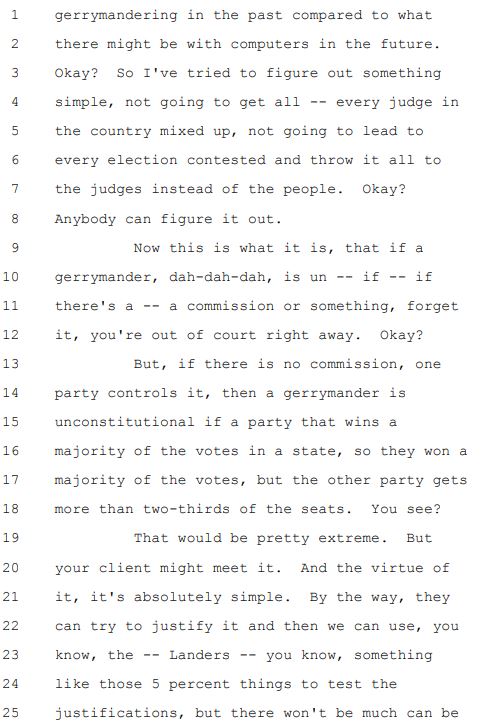
Following up on my prior monitoring of the length of Breyer questions, yesterday's oral argument in Lamone v. Benisek prompted the following question/hypothetical from Justice Breyer:


This 59-line Breyer "question," or "Breyer Page" appears to be a new record, as the last record I've been able to locate was a 57-line Breyer Page in Gill v. Texas that Josh Blackman flagged back in 2017. Audio of the argument is not yet available, so I do not know yet if this is the longest Breyer Question ever asked in terms of length of time.

READ MORE - A 59-Line Breyer Question

Labels:

The Supreme Court Will Hear the First Major Second Amendment Case in Nearly a Decade

Thursday

On Tuesday, the Supreme Court granted certiorari in a case challenging the constitutionality of New York City's regulations that restrict the carrying of firearms outside the home. The New York Times and Wall Street Journal have more reporting on the background of the case. From the New York Times:

The Supreme Court said on Tuesday that it would review a New York City gun law that limits residents from transporting their guns outside their homes, its first Second Amendment case in nearly a decade and a test of the court’s approach to gun rights after the arrival of Justice Brett M. Kavanaugh in October. 
Justice Kavanaugh, who replaced the more moderate Justice Anthony M. Kennedy and created a reliable five-member conservative majority, has an expansive view of gun rights. His presence most likely means that the Supreme Court will start exploring and perhaps expanding the scope of the Second Amendment.
The case is New York State Rifle & Pistol Association, Inc. v. City of New York, and the petitioners challenging New York's rule are an organization and several individual gun owners. The Second Circuit opinion that is being appealed is here.

New York Penal Law section 400.00(2)(a) and (f) provide for "premises" licenses and "carry" licenses for handguns. New York City's Rule regarding premises licenses states:
(a) Premises License – Residence or Business. This is a restricted handgun license, issued for a specific business or residence location. The handgun shall be safeguarded at the specific address indicated on the license. This license permits the transporting of an unloaded handgun directly to and from an authorized small arms range/shooting club, secured unloaded in a locked container. Ammunition shall be carried separately. (38 RCNY § 5-01(a)
This rule contains a number of restrictions, including that handguns be transported unloaded in a locked container, that ammunition be carried separately, and that handguns may be transported to "authorized" shooting ranges. The City acknowledges that there are seven authorized ranges in New York City. Holders of premises licenses are restricted from transporting firearms to shooting ranges outside of the city or to second homes, even if they are within the city (as this destination is not "an authorized small arms range/shooting club."

The Court has refused to take up Second Amendment cases since its 2010 ruling in McDonald v. City of Chicago in which it held that the Second Amendment's protections apply to the states. The Court had previously held in its 2008 ruling in District of Columbia v. Heller that the Second Amendment creates an individual right and that its core protection was of the possession of firearms for self-defense in the home. Since then, lower courts have applied a variety of approaches to the Second Amendment, as many of the cases they have confronted have involved rules or restrictions affecting the possession or carrying of firearms outside of the home. Noting Heller's statement limiting the core possession to self-defense in the home, and also noting language stating that the case should not cast doubt on other, "longstanding" restrictions on firearms, lower courts have typically restricted the scope of the Second Amendment. The Supreme Court has consistently refused to review these decisions -- including cases involving the carrying of firearms.

This is now likely to change, as there are now four conservative justices with expansive views of Second Amendment protections. These four justices create a block of four votes required to grant review of lower courts' decisions.

Justice Thomas, in particular, has consistently dissented from the Court's prior refusals to take up Second Amendment cases. He has been joined in these prior dissents by Justice Gorsuch (in this case involving California's restrictions on the carrying of firearms). Justice Alito likely shares Thomas's views, as reflected in his concurring-in-the-judgment opinion in Caetano v. Massachusetts, in which Alito (joined by Thomas) criticized the reasoning of the lower court opinion and argued that the Second Amendment's protection encompasses the possession of weapons commonly used today for self-defense. (As an aside, commentators will likely point to Alito's 1996 dissent from a case upholding a ban on machine guns, but that dissent is not particularly useful, as his analysis focuses on the Commerce Clause of the Constitution, and not on the Second Amendment). Justice Kavanaugh is likely to join Thomas, Gorsuch, and Alito in seeking a broad ruling on Second Amendment protections, as he has previously ruled that prohibitions on semi-automatic firearms are unconstitutional. (See page 46 of this opinion for the start of Kavanaugh's dissenting opinion while he was still on the DC Circuit).

Some commentators argue that the Supreme Court will likely overturn the Second Circuit's opinion and broaden the scope of Second Amendment protections. Mark Joseph Stern argues this in this Slate article and Garrett Epps makes a similar point over at The Atlantic. Both articles have exaggerated titles (Stern's claims that the Court will make all states' laws like Texas' laws and Epps' title raises the notion of "Supersizing" the Second Amendment). But the tone of each article suggests that these goofy titles are likely the choice of editors rather than the authors.

Stern writes:
The case thus marks an effort to inch the Supreme Court toward establishing a right to public carry without forcing the justices to tear down hundreds of laws in a single, sweeping ruling. For a decade, gun advocates have been stymied by the language in Heller and McDonald expressly limiting the Second Amendment to firearms “in the home.” The conservative justices, however, will probably use New York State Rifle to blur that line.
 And Epps notes:
The Rifle & Pistol case begins, then, with four virtually certain votes against the New York law—the two newcomers, Thomas, and Alito. Chief Justice John Roberts voted for the gun owners in Heller and McDonald. He may have been trying to keep the Court out of the Second Amendment area for institutional reasons since then, but that’s not likely to make him go back on his earlier votes when the time comes to throw down. 
“The impact of this case could be huge,” [Law Professor Adam] Winkler told me, because the Court may decide that the right to gun possession extends outside the home. The Court could undermine long-standing restrictions on concealed carry in America’s major cities, leading to hundreds of thousands more guns on the streets of Los Angeles, New York, and Washington, D.C.
Like Stern and Epps, I think that it's likely that the Court will overturn the Second Circuit opinion and strike down the New York City rule. The question then becomes how broad the Court's opinion will be. The New York City rule has several levels on which the justices may rule. A narrow ruling would overturn the rule based on its destination restriction, which prohibits premises license holders from taking their handguns anywhere other than an authorized shooting range. A broader ruling could strike down the law because it prohibits these license holders from carrying the handguns in a locked container separate from the ammunition. Such a broad ruling may be complicated by New York's alternate permit schemes -- which include concealed carry permits -- but there may be ways around this, such as a ruling striking down the locked container portion of the requirement only, while leaving the separate ammunition component intact.

There is also the question of how a broad determination of the Second Amendment's protection can make its way into the opinion. My first instinct, from looking at the layout of the Court and -- in particular -- Chief Justice Roberts's likely goal to avoid large changes in the law, is that there will likely be a majority opinion of Roberts, Alito, Gorsuch, Thomas, and Kavanaugh that overturns the law for its destination restriction, and a concurring opinion of the latter four justices that argues that the locked-case / no ammunition restriction is also impermissible.

A less-likely alternative is that Roberts will author an opinion that includes dicta that lays the foundation for a broader Second Amendment protection scheme. This would be similar to the paragraph in the Heller opinion that stated that "longstanding" restrictions on firearms (such as restrictions of criminals' possession of guns and prohibiting firearms in government buildings) were not cast into doubt by the opinion -- a paragraph that was reportedly added to gain Justice Kennedy's vote -- and which formed the basis of many restrictive lower court opinions in subsequent years. I think that an approach with language that leans in the opposite direction and calls for more Second Amendment protections is unlikely, as the most conservative justices will still join in the narrower majority opinion even if they write their own concurrence.

However the outcome may look in the end, it is likely that the Court will overrule the lower decision and, in doing so, hold that the Second Amendment provides at least some level of protection to the carrying of firearms beyond the home. However narrow the opinion is framed, this opinion would significantly broaden the scope of Second Amendment protections, and would likely lead to much more successful litigation against states and localities with strict restrictions on the carrying of firearms.

READ MORE - The Supreme Court Will Hear the First Major Second Amendment Case in Nearly a Decade

Labels:

The Tort of "Outrage"

Monday

CNN reports that, rather than prudently disappear, failed Senate candidate and former Constitution-ignoring Alabama Chief Justice Roy Moore has filed a lawsuit:

Failed Alabama Senate candidate Roy Moore says the women who accused him of sexual assault were part of a political conspiracy, according to a lawsuit filed Monday. 
The suit was jointly filed with his wife, Kayla, about an hour before the two held a news conference. It was Moore's first public appearance since election night in December, when Moore, a Republican, was upset by Democrat Doug Jones.
I'm pleasantly surprised to see that CNN links to a copy of the Complaint.

I'm not going to delve into the merits of the litigation, although Moore's theory -- that it's curious that allegations against him were not raised earlier -- strikes me as flimsy. I'm sure the merits of his lawsuit have been and will be analyzed by others in far greater depth. Instead, I want to focus on Moore's sixth cause of action for "Outrage." The pertinent allegation under that cause of action states:

66. At the aforesaid times and places, Defendants—with the intent to cause severe damage to the Plaintiffs’ reputation and standing in the community—intentionally or recklessly engaged in extreme and outrageous conduct that caused emotional distress so severe that no reasonable person could be expected to endure it. Fully aware of the probable emotional impact their actions would have on the Plaintiffs, the Defendants nonetheless recklessly and willfully disregarded the consequences of their actions.
I've never heard of a cause of action for outrage, but after a bit of research it appears that Alabama courts recognize this cause of action as an alternate name for the cause of action for intentional infliction of emotional distress. The Alabama Supreme Court provides some background on this in Thomas v. BSE Indus. Contractors, Inc.:

This Court first recognized the tort of outrage, or intentional infliction of emotional distress, in American Road Service Co. v. Inmon, 394 So.2d 361 (Ala.1981). In Inmon, the Court held that to present a jury question the plaintiff must present sufficient evidence that the defendant's conduct (1) was intentional or reckless; (2) was extreme and outrageous; and (3) caused emotional distress so severe that no reasonable person could be expected to endure it. The Court defined the second element of the tort of outrage as follows: "By extreme we refer to conduct so outrageous in character and so extreme in degree as to go beyond all possible bounds of decency, and to be regarded as 1044*1044 atrocious and utterly intolerable in a civilized society." Inmon, 394 So.2d at 365 (quoting Restatement (Second) of Torts, § 46 cmt. d, at 72 (1948)).
This makes sense when you compare Moore's cause of action for outrage with the allegation underlying his cause of action for intentional infliction of emotional distress:

64. At the aforesaid times and places, and for some time prior Defendants, with the intent to cause damage to the Plaintiffs, did intentionally utter, produce, and disseminate spoken and written communications to harm the reputation and character of Roy Moore. The aforesaid outrageous and shocking acts were done with the intent of causing emotional distress and injury to Roy Moore and Kayla Moore and were a proximate cause of the Plaintiffs’ injuries as described above, herein.
Why does Moore allege two causes of action that are essentially the same? One possibility is that, until recently, Alabama courts appear to have taken a notably narrow approach to the tort of outrage.  A relatively recent opinion by the Alabama Supreme Court in Wilson v. University of Alabama Health Services Foundation held that it was error to apply too narrow of an approach to the tort:

This Court has previously recognized the tort of outrage in three circumstances:
"The tort of outrage is an extremely limited cause of action. It is so limited that this Court has recognized it in regard to only three kinds of conduct: (1) wrongful conduct in the family-burial context, Whitt v. Hulsey, 519 So. 2d 901 (Ala. 1987); (2) barbaric methods employed to coerce an insurance settlement, National Sec. Fire & Cas. Co. v. Bowen, 447 So. 2d 133 (Ala. 1983); and (3) egregious sexual harassment, Busby v. Truswal Sys. Corp., 551 So. 2d 322 (Ala. 1989). See also Michael L. Roberts and Gregory S. Cusimano, Alabama Tort Law, § 23.0 (2d ed. 1996)."
Potts v. Hayes, 771 So.2d 462, 465 (Ala. 2000). However, as Wilson notes in her brief, this Court has not held that the tort of outrage can exist in only those three circumstances: 
"That is not to say, however, that the tort of outrage is viable in only the three circumstances noted in Potts. Recently, this Court affirmed a judgment on a tort-of-outrage claim asserted against a family physician who, when asked by a teenage boy's mother to counsel the boy concerning his stress over his parents' divorce, instead began exchanging addictive prescription drugs for homosexual sex for a number of years, resulting in the boy's drug addiction. See O'Rear v. B.H., 69 So. 3d 106 (Ala. 2011). It is clear, however, that the tort of outrage is viable only when the conduct is `"so outrageous in character and so extreme in degree as to go beyond all possible bounds of decency, and to be regarded as atrocious and utterly intolerable in a civilized society."' Horne v. TGM Assocs., L.P., 56 So. 3d 615, 631 (Ala. 2010) (quoting [American Road Service Co. v.] Inmon, 394 So. 2d [361, 365 (Ala. 1980)])." 
Little v. Robinson, 72 So. 3d 1168, 1172-73 (Ala. 2011) (emphasis added).
The Court went on to overturn the trial court's holding that the cause of action for outrage is only limited to "three situations." With restrictive case law like Potts on the book, however, and with the Wilson decision only being published in December 2017, it's not surprising that a plaintiff who might not be aware of the recent Wilson decision might also want to assert a cause of action for intentional infliction of emotional distress to get around the restrictive-sounding precedent.

Additionally, the extra cause of action makes the Complaint look all the more impressive without much risk. After all, the Alabama Supreme Court in Birmingham Railway & Electric Co. v. Baylor (a case that is very old and which does not appear in full on Google Scholar and which I am not going to devote resources or time towards cite-checking),  notes that "mere redundancy will not vitiate a complaint." (at p. 494).

Moore likely won't lose anything by adding in what is essentially a restatement of his cause of action for intentional infliction of emotional distress, and will gain what appears to be an additional cause of action -- a cause of action for "Outrage," no less!

READ MORE - The Tort of "Outrage"

Labels:

Bacongate: Did Senator Leahy Read My Confirmation Hearing Outline for Justice Willett?

Wednesday

Business Insider reports on a ridiculous exchange between Senator Patrick Leahy (D-VT), and Fifth Circuit Court of Appeals Judicial Nominee, Texas Supreme Court Justice Don Willett, a video of which is below:


Back when Justice Willet was being considered as a potential Supreme Court nominee, I wrote this post highlighting questions that could be asked at Willett's confirmation hearing based on his prior tweets. From that post, here is one of my potential questions (and the accompanying tweet):

As a Supreme Court Justice (or federal judge) would you be willing to expand the Supreme Court's previous decisions that expanded the definition of marriage?


In a fascinating display of either: (1) failing to understand simple humor; or (2) extreme partisan interpretation, Leahy lambasted Willet's tweet as an attack on gay marriage and the Supreme Court's decision legalizing gay marriage. From Business Insider:
"I don't think one would see that as praising the Supreme Court decisions," Leahy said of the tweet.
While I am happy that I was able to predict at least one of the tweets that would come up in Willett's confirmation hearing, Leahy taking the tweet in this direction made a farce of his line of questioning. Senators with concerns about Willett taking conservative stances on legal issues certainly have plenty to work with, but this exchange is just (to use some legal terminology) goofy.

All of this aside, I will assume without evidence that Senator Leahy got the idea to ask about that tweet by reading my blog, and I thank the good Senator for his attention to my work.

READ MORE - Bacongate: Did Senator Leahy Read My Confirmation Hearing Outline for Justice Willett?

Labels:

Court Denies Sheriff Joe Arpaio's Request to Vacate All Orders and Dismiss Case Following Pardon

Friday

NPR reports:
U.S. District Judge Susan Ritchie Bolton says that President Trump's pardon of former Maricopa County Sheriff Joe Arpaio does not "revise the historical facts" of his case — and that she will not vacate her ruling that found Arpaio guilty of criminal contempt.
On Thursday, Bolton quoted Black's Law Dictionary to say that a pardon "releases the wrongdoer from punishment and restores the offender's civil rights without qualification." But she then added a further interpretation in her own words: "It does not erase a judgment of conviction, or its underlying legal and factual findings."
The NPR story contains a copy of the Order, but a complete copy of the Order can be found here. Additional coverage of this most recent development can be found here and here. Arpaio's attorneys have filed a notice of appeal of the ruling. My own discussion of the Arpaio pardon can be found here.

I do not have a time to do my own research on the law of pardons in the Ninth Circuit, but from the court's focus on the law of other circuits it appears that there does not seem to be any clean, controlling precedent in the Ninth Circuit. The court was not persuaded by Arpaio's reliance on U.S. v. Schaffer in which the DC Circuit vacated all orders following a pardon. The judge noted that due to the procedural background of Schaffer, the only issue pending was the court's grant of a new trial to Schaffer, which left Schaffer in a position "as if no trial had ever taken place." Accordingly, the seemingly broad order in Schaffer had a limited effect, which distinguished the ruling in Schaffer from Arpaio's broader request.

When this Order is appealed, I expect that the quick discussion in footnote one of the Order will be expanded upon. Here is the text of that footnote (with hyperlinks to the text of the cited cases added):

The United States Supreme Court originally signaled in dicta that a presidential pardon may have an expunging effect. See Ex Parte Garland, 71 U.S. (4 Wall.) 333, 380-81 (1866) ("A pardon reaches both the punishment prescribed for the offence and the guilt of the offender; and when the pardon is full, it releases the punishment and blots out of existence the guilt, so that in the eye of the law the offender is as innocent as if he had never committed the offence."). The Court later rejected this view. See Burdick v. United States, 236 U.S. 79, 94 (1915) ("[A pardon] carries an imputation of guilt; acceptance a confession of it."). Other courts have followed suit. See, e.g., In re North, 62 F.3d 1434, 1436-37 (D.C. Cir. 1994) (finding Garland dicta not controlling); United States v. Noonan, 906 F.2d 952, 958-59 (3d Cir. 1990) (same); Bjerkan v. United States, 529 F.2d 125, 128 n.2 (7th Cir. 1975) (same).
As the case works its way up through appeals, I suspect that discussion of the Supreme Court precedents and their interactions will move from the footnotes to the text of whatever opinions result. And if the law in the Ninth Circuit addressing this pardon issue is as absent as it seems from Judge Bolton's order, it will be interesting to see how the Ninth Circuit addresses the issue. In the end, I suspect that the ruling will not be favorable to Arpaio, but if the Ninth Circuit takes a thorough approach to the analysis (see, e.g., the approach in Noonan), the decision could be a notable contribution to this rarely-litigated area of law.

READ MORE - Court Denies Sheriff Joe Arpaio's Request to Vacate All Orders and Dismiss Case Following Pardon

Labels:

Trump to Nominate Justice Don Willett for Fifth Circuit

Thursday

So reports San Antonio Express-News:

President Trump on Thursday will nominate two conservatives from Texas with compelling personal stories to the 5th U.S. Circuit Court of Appeals, according to a senior administrative official.
Texas Supreme Court Justice Don Willett was cited by Trump as a potential U.S. Supreme court pick during his presidential campaign. Dallas appellate lawyer James Ho is a former Texas solicitor general who has argued cases before state and federal courts.
Willett -- a prolific Twitter user whose wit with more than 96,000 followers and the title of Texas “Tweeter Laureate” --had gently mocked Trump in some tweets during the campaign for the White House.
The article has a collection of some of Justice Willett's "gently mock[ing]" tweets.

I had previously blogged about Justice Willett back in the heyday of speculation as to who Trump would nominate to fill the Supreme Court seat left vacant by the death of Justice Antonin Scalia. At the time, Justice Willett was on Trump's list of potential nominees, although Trump ultimately nominated now-Justice Neil Gorsuch to the Court.

It will be interesting to see whether Justice Willett faces heightened scrutiny in his confirmation hearing given his prior inclusion on Trump's list of potential Supreme Court nominees. Justice Willett also may have a wider public profile than some of Trump's other nominees in light of his active, and often humorous, Twitter account. This, coupled with existing dissatisfaction by Democrats on the Senate Judiciary Committee may lead to some interesting exchanges whenever the hearings end up taking place.

READ MORE - Trump to Nominate Justice Don Willett for Fifth Circuit

Labels:

Talking in Public: A Cautionary Tale for Lawyers

Tuesday

Kenneth Vogel of The New York Times has this remarkable story that should serve as a cautionary tale for all attorneys who may feel tempted to speak about their cases and clients outside of the office. Vogel reports that he was getting lunch with a source in a Washington DC restaurant, when he noticed Ty Cobb, the attorney retained by the White House to assist in responding to various Russia investigations, having a conversation with John Dowd, Trump's "lead outside counsel in the Russia investigations."

Mr. Cobb was not difficult to notice, on account of his incredible moustache:


Mr. Cobb chose to discuss his work in representing the White House in the Russia investigations, and apparently talked loudly and extensively enough about his work to give rise to this story detailing the conflict among Trump's attorneys over the proper level of cooperation in the Russia investigations.

From Vogel's article describing how he got the scoop:
I ordered yet another iced tea, and continued typing away, as Mr. Cobb and Mr. Dowd delved deeper, not paying me any mind.
They discussed presidential privilege and its effect on document production, tensions on the legal team and their colleagues. Mr. Cobb suggested one colleague was not on the president’s good side, but added, “I’m trying to get the president not to pick a fight with her.”
Finally, after more than 45 minutes of my assiduously listening to their conversation by myself, Mr. Cobb picked up the check and announced to Mr. Dowd, “All right, boss, I got to roll back to my little hole. I’ve got like a seven and a half foot ceiling ... Wilt Chamberlain couldn’t stand up in it.”
Attorneys are often warned during training or in law firm policies to avoid discussing matters related to their work in public settings. Whether it is in a restaurant, on the sidewalk, or in the elevator, attorneys should avoid discussing clients and cases, as any information communicated to lawyers is privileged, and attorneys' strategies and theories are protected by the work product doctrine. Speaking up about privileged information in a public setting is a very easy way for an attorney to run into serious problems.

Warnings against public discussion of work are often confined to the hypothetical elevator or restaurant. But Vogel's article gives a spectacular real-world example of what attorneys everywhere should avoid doing.

READ MORE - Talking in Public: A Cautionary Tale for Lawyers

Labels:

Recent Equifax Breach Prompts Criticism of Arbitration Provisions (Updated)

Friday

The credit monitoring firm, Equifax, recently suffered a massive data breach, resulting in the exposure of the personal information of approximately 143 million Americans. This personal information includes names, Social Security numbers, birth dates, and addresses.

Equifax, realizing how terrible this is, has tried to respond by offering free credit report monitoring services to its customers for a year. But this isn't going over very well, as it appears that Equifax may be attempting to get people to waive their class-action rights and agree to binding arbitration provisions by signing up for the credit-monitoring service. From the Wall Street Journal:

The fine print in the Equifax agreement concerning the monitoring services said that consumers who take part waive the ability to bring or participate in a class-action suit, a class arbitration or other similar legal actions. That seemed to suggest that consumers would be bound to an individual arbitration process with the company, which some argue is a more difficult place for consumer to get larger rewards for their problems.
The Washington Post has similar reporting here, and a report from MarketWatch is here.

The Terms of Service that contain the "fine print" can be found here. Here is the relevant provision:
Binding Arbitration. Any Claim (as defined below) raised by either You or Equifax against the other shall be subject to mandatory, binding arbitration. As used in this arbitration provision, the term "Claim" or "Claims" means any claim, dispute, or controversy between You and Us relating in any way to Your relationship with Equifax, including but not limited to any Claim arising from or relating to this Agreement, the Products or this Site, or any information You receive from Us, whether based on contract, statute, common law, regulation, ordinance, tort, or any other legal or equitable theory, regardless of what remedy is sought. This arbitration obligation extends to claims You may assert against Equifax’s parents, subsidiaries, affiliates, successors, assigns, employees, and agents. The term "Claim" shall have the broadest possible construction, except that it does not include any claim, dispute or controversy in which You contend that EIS violated the FCRA. Any claim, dispute, or controversy in which You contend that EIS violated the FCRA is not subject to this provision and shall not be resolved by arbitration.
The key in this paragraph is the definition of "Claim," which is sufficiently broad to cover damages arising from the data breach (as these damages presumably arise from one's relationship with Equifax).

Equifax may claim that the Terms of Service linked to above do not apply to customers who enroll in the "TrustedID Premier" program that Equifax is offering after the breach. That program is linked to from this page (with a URL of www.equifaxsecurity2017.com). The Terms of Service associated with the TrustedID program are here, and while they also contain a pretty stringent-sounding arbitration provision, it does not contain the same, extremely broad "Claim" definition. [NOTE: See update below].

But the Terms of Service that I initially quoted should still apply to those who enroll in the TrustedID service because those Terms are extremely broad in their potential application:
THIS PRODUCT AGREEMENT AND TERMS OF USE ("AGREEMENT") CONTAINS THE TERMS AND CONDITIONS UPON WHICH YOU MAY PURCHASE AND USE OUR PRODUCTS THROUGH THE WWW.EQUIFAX.COM, WWW.IDENTITYPROTECTION.COM AND WWW.IDPROTECTION.COM WEBSITES AND ALL OTHER WEBSITES OWNED AND OPERATED BY EQUIFAX AND ITS AFFILIATES ("SITE"). YOU MUST ACCEPT THE TERMS OF THIS AGREEMENT, INCLUDING THE ARBITRATION AGREEMENT CONTAINED IN SECTION 4 BELOW, BEFORE YOU WILL BE PERMITTED TO REGISTER FOR AND PURCHASE ANY PRODUCT FROM THIS SITE. BY REGISTERING ON THIS SITE AND SUBMITTING YOUR ORDER, YOU ARE ACKNOWLEDGING ELECTRONIC RECEIPT OF, AND YOUR AGREEMENT TO BE BOUND BY, THIS AGREEMENT. YOU ALSO AGREE TO BE BOUND BY THIS AGREEMENT BY USING OR PAYING FOR OUR PRODUCTS OR TAKING OTHER ACTIONS THAT INDICATE ACCEPTANCE OF THIS AGREEMENT.
Sorry for all the capital letters. I strongly suspect that attorneys who draft terms of service agreements are secretly angry people, and sometimes the rage manifests itself in the work product.

In case you cannot read the paragraph above, it applies the terms in the Agreement to all websites owned and operated by Equifax and its Affiliates.

In response to critics pointing out how Equifax appears to be systematically herding potential Plaintiffs' into agreeing to binding arbitration, Equifax has set up this "Progress Update" page where it tries to put out the new fire that it has caused:
2). NO WAIVER OF RIGHTS FOR THIS CYBER SECURITY INCIDENT
In response to consumer inquiries, we have made it clear that the arbitration clause and class action waiver included in the Equifax and TrustedID Premier terms of use does not apply to this cybersecurity incident.
Have they though?

Let's go back to the Terms of Service -- specifically, to the relevant portion of the integration clause near the end:
ENTIRE AGREEMENT BETWEEN US. This Agreement constitutes the entire agreement between You and Us regarding the Products and information contained on or acquired through this Site or provided by Us, including through other linked third party Internet sites.
This appears to exclude Equifax's damage control statements, which appear on a separate page and are not included in the terms of the Agreement. All Equifax would need to do would be to point to this clause and argue that its statements elsewhere about the arbitration agreement not applying are of no legal relevance.

In short, commentators who are criticizing Equifax's response seem to have a pretty good point. Signing up for Equifax's free (for a year) credit report monitoring service may result in a waiver of rights that the average consumer would not expect, and likely would not agree to if it were put into plain English.

All of this may end up being moot, however, as signing up for the credit monitoring service requires customers to give Equifax the last six digits of their Social Security numbers. Perhaps those willing to entrust Equifax with this information following a breach of this magnitude are willing to agree to just about anything, including a waiver of the right to trial and right to join in a class action.

[UPDATE: 9/11/2017]

I have revised the post above to add the link to the TrustedID Program Terms of Use, which I had not linked to in the original post. Additionally, at the time I wrote the initial post, the TrustedID Program's Terms of Use included an arbitration provision, albeit one that was less all-encompassing than the provision in Equifax's general Terms of Service Agreement. The TrustedID Program's Terms of Use have now been updated and no arbitration provision appears in these terms at all. The TrustedID Agreement contains integration clause near the end of the Agreement, which states, in pertinent part:
ENTIRE AGREEMENT BETWEEN US. This Agreement constitutes the entire agreement between You and Us regarding the Products and information contained on or acquired through this website or provided by Us, including through other linked third party Internet sites.
This may have the effect of fulfilling Equifax's promise that their arbitration provisions do not apply to the recent breach. Users affected by the breach could visit the webpage for the TrustedID Program without ever accessing Equifax's general website (say, by linking to the TrustedID page from the link in the post above). And while the broad terms of Equifax's general Terms of Use still apply, Equifax would probably have a harder time arguing in court that customers are bound to the general Terms of Use if those customers could have enrolled in the TrustedID Program without ever visiting (or being prompted to visit) a page containing or linking to Equifax's general Terms of Use.

In short, users looking to enroll in the TrustedID Program now have a much stronger argument that they have not agreed to arbitration and may still pursue claims in court, either as individuals or through a class action. Of course, I just checked the TrustedID page and it is still seeking the last six digits of my Social Security Number ... so users still must decide whether entrusting Equifax with this information following the breach is a prudent action to take.

READ MORE - Recent Equifax Breach Prompts Criticism of Arbitration Provisions (Updated)

Labels:

Blogger Theme By:GosuBlogger and Araba Modelleri .