Powered by Blogger.
amazon | BUY NOW | BUY NOW

Showing posts with label humor. Show all posts

How Many Times Can a Complaint Be Amended?

Thursday

This post aims to answer a simple question: what is the highest number of amendments to a complaint that has ever been allowed by a court in the United States?

A bit of background first. This post concerns civil litigation, where plaintiffs typically file a complaint setting forth various causes of action against defendants who have allegedly wronged them. These complaints are often amended. Sometimes plaintiffs add or remove parties. Plaintiffs may also add or remove causes of action or factual allegations in support of their causes of action. A defendant may move to dismiss a complaint, and if they succeed, the court may grant the plaintiff leave to file an amended complaint. Granting leave to amend at least once is common--unless a defendant has clearly demonstrated that a plaintiff's case is completely futile, a court will likely give the plaintiff another shot.

While many cases I've litigated have involved amended, second amended, or even fourth amended complaints, I was curious about the maximum number of amendments courts have allowed. A first amended complaint isn't too hard for a plaintiff to get. But when a court is confronted with a complaint that has been drafted and redrafted multiple times, the probability that the court will give a plaintiff yet another chance decreases.

From my exhaustive research (searching for "tenth amended complaint" and increasing the numbers until I could find no further results), it appears that the most amended complaint on record was amended twenty-two times.  The case is Mirarchi v. Boockvar, and it's a recent one--with the original complaint filed on January 12, 2021 in the US District Court for the Eastern District of Pennsylvania (case no. 5:21-CV-00126). A publicly-accessible link to the docket is here.

I've answered the question I set out to investigate, but I dug into the case itself, as I was curious about what would give rise to so many amendments. For those of you brave enough to dive into that nonsense, read on:

The original complaint can be viewed here. It's one of the numerous lawsuits filed in the wake of the 2020 presidential election that alleged the election had been stolen as a result of massive voter fraud. Mirarchi's allegations start off as readable, but quickly veer off on a tangent in which he claims that the total number of votes that Biden received was "interconnected" with "the Golden Ratio Squared, 2.61803399, and a Reconstruction Cost Value, 601118," which had allegedly been used against Mirarchi in a separate litigation matter involving building appraisal numbers (which appears to be this case). From there, things only get more complicated, as Mirarchi claims that calculations using these numbers end up equaling Biden's total number of votes, thereby revealing fraud.

For example, here's one of the paragraphs:

Here's another:


Mirarchi wraps up these mathematical allegations with a reference to widely and repeatedly discredited allegations by Sidney Powell which she now argues no reasonable person would believe as she tries to escape liability in a defamation suit filed by Dominion Voting Systems. Mirarchi's causes of action include election fraud, treason, RICO, and a 42 USC § 1983 claim for violation of his constitutional rights.

The circumstances behind the amendments to this complaint are unclear. For several weeks in January and February 2021, Mirarchi filed further amended versions of his complaint on a near-daily basis, culminating in a Twenty-First Amended Complaint that was filed on February 12, 2021. At that point the court ordered Mirarchi to combine his allegations into a Final Amended Complaint, after which no further amendments would be permitted. The Plaintiff filed that Final Amended Complaint (the twenty-second amended complaint, and the twenty-third iteration of the document) on March 3, 2021.

A motion to dismiss was filed by several of the county defendants on April 26, 2021. The Court has ordered other defendants to respond by May 26 and has granted leave for federal defendants to respond by July 16, 2021. Accordingly, it may be some time before we see whether a Twenty-Third Amended Complaint ends up getting filed.

READ MORE - How Many Times Can a Complaint Be Amended?

Labels:

Can You Serve Legal Documents Via Pigeon?

It's been a while, but I'm back to answer the important questions. Today's pigeon-themed inquiry is not inspired by any news stories or current events. Instead, it popped into my head and demanded an immediate answer. Those who would like to know the answer, and learn some trivia about pigeons and related laws should read on.

As a bit of background, carrier pigeons (or homing pigeons) are pigeons that have been bred to find their way back to a fixed point even after being transported over long distances. Pigeons may be trained to carry small packages containing messages or other items. Because pigeons can only return to a fixed point, the person sending the message must have a pigeon that will return to the recipient's location. As this New York Times article details, pigeons have been used for sending messages, samples of blood, and other items over long distances, and have been employed in multiple wars to send communications from the field. In the John Wick universe, the Bowery King uses pigeons to send messages and small objects.

Naturally, this prompts the question of whether pigeons may be used to effectuate service of pleadings or documents in litigation. Case law on whether sending a document by pigeon constitutes valid service is limited. From what I could find in a cursory search, no US court has directly addressed a situation where a party has attempted to serve a legal document on someone using a pigeon. A couple courts have considered pigeon-service as a hypothetical scenario, but both appear to disapprove of the practice. 

In Geiling v. Wirt Financial Services, Inc., No. 14-11027; 2014 WL 8473822 (E.D. Mich. Dec. 31. 2014), the plaintiffs took issue with documents that had been produced in discovery that contained the plaintiffs' social security numbers, claiming that the mailing of these documents violated a Michigan state law against transmitting full social security numbers through the mail. The court noted an exception to this rule for documents sent by mail pursuant to legal discovery or process. The plaintiffs argued that this exception should not apply and the court disagreed, noting that the Michigan Court Rules envisioned that parties would produce documents in discovery through first-class mail. The court further suggested that "parties sending documents by untrustworthy means, carrier pigeon for example, could be faulted for operating outside normal discovery bounds," but not parties using standard methods to mail documents. (emphasis added). This suggests that the court would view service by carrier pigeon as a method of service outside of normal discovery practices, but a direct ruling on the issue must wait for another day.

In Seibold v. Commissioner of Dept. of Motor Vehicles, No. HHBCV136019840S; 2014 WL 565905 (Ct. Sup. Ct., Jan. 9, 2014), the court addressed whether a party had properly served an appeal by fax on the Office of the Attorney General, even though the rules required service by certified mail or personal delivery. The party claimed that because the Attorney General had actual notice of the appeal and had not been prejudiced by the failure to make proper service, her case should not be dismissed. The court rejected the plaintiff's argument, noting that at "its logical extreme" the argument would allow "service of the appeal on the agency by any means, including by a carrier pigeon, as long as the agency actually receives the appeal and is not prejudiced." (emphasis added). This, the court concluded, was not supported by statute or case law.

In summary, while courts have not directly addressed a situation where a party has attempted service using a pigeon, the disapproval of the method expressed by the few courts that have contemplated such a scenario means that it is probably is not advisable to do so.

Practically, service by pigeon is unlikely to catch on. The most apparent barrier to wide usage of homing pigeons is the fact that the person sending a document via pigeon must already have a pigeon in their possession that will return to the recipient. This suggests that a network of homing pigeons trained to deliver documents to law firms and courts must be supported by a secondary network of delivery personnel who take the pigeons from the recipients to the senders. Pigeons may be seen as redundant if a system for their physical delivery is already in place.

Another potential criticism of the practice is that even the smallest filing or item of correspondence is too large to be carried by a pigeon. The answer to this, however, is that these documents could be loaded onto tiny flash drives that could, in turn, be deposited into a pack that the pigeon can carry.

States considering permitting service via pigeon may be encouraged to learn that there are already legal barriers in place to prohibit interference with homing pigeons. In Pennsylvania, for instance, it is a summary offense to shoot, maim, or kill a homing pigeon. Similar restrictions exist in Michigan, Virginia, and Wisconsin. Laws like these may assuage concerns that interlopers will interfere with pigeons used for legal service.

READ MORE - Can You Serve Legal Documents Via Pigeon?

Labels:

Yes, It's Possible for a Dead Person to Win at Trial by Combat

Saturday

I'm writing a paper on trial by combat in my spare time because these days, what else is there to do? I've written about the subject before, both on this blog and in an article I coauthored with my former law school classmate, Raj Shah. Why I have such an enduring interest in the subject is unclear. Perhaps after days spent working on various civil litigation matters, reading accounts of cases where people physically battle each other to resolve their disputes makes my job seem calm by comparison.

I found one particularly quirky story of trial by combat in the short article, His Body Shall be Brought to the Lists, by W. Croft Dickinson. Dickinson notes that, in cases of trial by battle that involve "a cause touching life and limb," the party responding to the accusation of the crime (the "defender," or in a more modern sense, the "Respondent"), is obliged to appear for the battle within two weeks. If the Respondent dies within that time, his pledges (people who swore that he would appear) would bring his corpse to the area where the battle was to take place (the "lists.") After all, they had sworn an oath that they would ensure that the Respondent would appear and would make sure that their oath was fulfilled, even if the Respondent had died.

Dickinson then describes what happens when a dead body is brought to the lists. From "The Lawe of Armes Within Listis," Dickinson provides the following quoted account--with very little clarification or explanation:

It mycht fal sa that the appellour deis before the day; his borowis, quilk ar bound wndir gret panis, cummis and enteris his ded cors within the barreris to freith thaim of thair borowgang. The defendour, lik as he fand borowis, is enterit within [the] barreris; he findis the provour ded, and he can nocht sla a slane man; and he him self wnpurgit of the crime quhilk that the provour, that thair is deid, put upoun him. Than has he na recover bot to cast this ded cors our the barreris or the day be gane, or ellis the frendis of the ded man] may allege that the luffand man had tynt his actioun and ask him to be justifeit thairfor. Bot it mycht be allegit that [[an] assise war metast than; or ellis a campione for the appellour that is ded to mak gud it that he tuk apon hand, gif the juge and partii will admytt him.
Bot as to that purpose I haf herd that that samyn impediment com anys to preiff and [lege in] the kynrik of spanye, that quhen the ded man wes laid within barreris he wes sa hevy that the liffand man was nocht of mycht to put this ded cors out of [the] barreris, and al the day wes in hand thairwith quhill the son wes gane doun. And than the frendis of the ded man come before the Juge and askit the law of armes, and allegit that the peremptour day wes passit and thair frend had wonnyn his accioun; for he had nothir said the word ne wes not put out of the feld thocht he wes ded. And sua be the law of armes the ded man wan the quyk, and he demanyt as culpable of that actioun; and this wald the law of armes. And sum sais that as this quyk man wald haf castin the ded man our the barreris he fell bakwart on his bak and the ded man on his brest, and cud nocht avoid him of him quhill the day wes passit. And sua be the law he wes jugit in the crime and justifeit hairfore.

To my knowledge, nobody has taken up the task of translating this account from the old Scottish vernacular that was in vogue at the time (around the 1400s). While I am sure there are people better qualified than me to do this, I have a paper to write and I'm not going to wait around for them to get to this, so here is my attempt at a translation:

It might happen that the appellour ["Appellant" -- the party making the accusation of the crime, and responding to a demand for trial by battle] dies before the day; in which case his pledges, who are bound under great pains, come and enter his corpse within the lists [the area where the fight was held], to free them of their responsibility.  The defendour ["Respondent" -- the party accused of the crime, who demands trial by battle], along with his pledges, enters within [the] lists; he finds the Appellant dead, and he cannot slay a slain main; and he himself is unabsolved of the crime which that the appellant; who is there dead, put upon him.  At this point, he has no remedy but to cast the corpse out of the lists before the day is over [before sunset], or else the friends of the dead [man] may allege that the accused man is guilty of his alleged actions and ask him to be adjudicated guilty as a result.  But it might be alleged that that the respondent has met the challenge, as the Appellant's champion is already dead.
But as to that purpose, I have heard that same impediment came to proof in the country of Spain, and when the dead man was laid within the lists he was so heavy that the living man was not strong enough to put his corpse out of [the] lists, and was there all day until the sun went down.  And then the friends of the dead man came before the judge and requested the law of arms, alleging that the day had passed and their friend had won his action; for he had neither said the word ["recreant," or "craven" -- spoken to surrender the battle] nor was he put out of the field though he was dead.  And so, by the law of arms, the dead man defeated the accused, who was found culpable of his alleged conduct; and this was the law of arms.  And some say that as this accused man attempted to cast this dead man over the barriers, he fell backwards on his back, and the dead man was on his breast, and he could not free himself before the day had ended.  And so, by the law, he was judged in the crime and therefore adjudicated guilty.

Some notes on terminology: the "Appellant," is the party making a private accusation of a crime against another party--typically known as an appeal of felony or appeal of murder (in cases where involving allegations of murder).  This is not to be confused with a situation where a party appeals from some lower action (although in some cases, an appeal of felony or murder could follow after a party had been acquitted or pardoned of a crime). And while the term "trial by battle" may be more in line with language used in historic accounts of the practice, I use "trial by combat," as this is the more commonly used phrase today (thanks, Game of Thrones).

My reading of the text differs from the scenario Dickinson discusses at the start of his article.  Dickinson contemplates a situation where a party accused of a crime (the defender, or--in the terminology I chose, the "Respondent") dies before the trial by combat against the accuser, (aka the "Appellant," "appelour," or "provour") takes place. But the text discusses what happens if the Appellant dies before the battle--and the conundrum faced by the accused who finds himself unable to battle against a dead person.  The solution, apparently, is for the living to "put forth" the dead man from the lists, that is, toss him out of the ring--a seemingly simple task.

Not so for the poor fellow described in the story, who tried to throw his opponent's corpse out of the lists, but instead ended up being pinned under the body.  As he was unable to free himself before sunset, he was adjudicated to have lost, as the dead man had not been thrown out of the lists, nor had the dead man verbally signaled that he had surrendered.

As I am writing this, people all over the world are going through tough times. Many of us are stuck inside, some of us have lost our jobs or suffered reductions in pay, and all of us are stressed over the state of the economy and the health of the nation. Perhaps we can all take comfort in the fact that, at the very least, we haven't been found guilty of a crime because we failed to win at trial by combat against a dead person.

(NOTE: Translating old Scottish texts is not my day job, and I welcome any comments on words or phrases I messed up. The last sentence of the first paragraph was unclear, and my version is largely a guess based on context.  I translated "justifeit" as "adjudicated guilty," based on the context in which the term was used, and based on similar usage of the term in other sources.  I translated "borrowgang" as "responsibility," although it appears that this is a technical term that may be more akin to "suretyship."  I could not find a translation for "luffand," which I translated as "accused," based on the context.  The same is true for "wnpurgit," which received a whopping zero results on Google and which I translated as "unabsolved," based partly on the context and based on the similarity of part of the word to "purged.")

READ MORE - Yes, It's Possible for a Dead Person to Win at Trial by Combat

Labels:

Kansas Man Demands Trial By Combat in Iowa Court

Thursday

From the conversations, texts, emails, and messages of dozens of friends, coworkers, and former classmates (all of whom are dead-on when it comes to pinpointing my legal interests), I learned about this story of a Kansas man who demanded trial by combat in an Iowa divorce case.  The story was first reported a few days ago, but I've been busy.


Those who know me, who have read this blog, or who have read papers that I have co-authored should not be surprised that this case is right up my alley. 

The Des Moines register reports:
A Kansas man has asked an Iowa court to grant his motion for trial by combat so he can meet his ex-wife and her attorney "on the field of battle where (he) will rend their souls from their corporal bodies." 
David Ostrom, 40, of Paola, Kansas, claims in court documents that his ex-wife, Bridgette Ostrom, 38, of Harlan, has "destroyed (him) legally." 
He asked the Iowa District Court in Shelby County to give him 12 weeks "lead time" in order to source or forge katana and wakizashi swords, as first reported by the Carroll Times Herald. 
"To this day, trial by combat has never been explicitly banned or restricted as a right in these United States," Ostrom argues in court records, adding that it was used "as recently as 1818 in British Court."

When reached by phone Monday, Ostrom told the Des Moines Register that he got the idea after learning about a 2016 case in which New York Supreme Court Justice Philip Minardo acknowledged that duels had not been abolished.
The story has been widely reported, but most of the other articles rehash the same points. Kevin Underhill at Lowering the Bar provides good legal coverage here, including a discussion of the relevant case law that Iowa's court would likely cite to reject Ostrom's request.

Here's a report on the story from KCTV5 News. It includes a video of an interview with Ostrom, who claims that "I'm not interested in physically causing harm to anyone." This is something of a shift in tone from the goal of rending souls from "corporal bodies" expressed in his moving papers.

(Ostrom later admitted that his demand contained a spelling error and that he had intended to write "corporeal bodies.")

If you want a copy of Ostrom's papers, or the response filed by his ex-wife's attorney, you're out of luck because none of the news outlets that are reporting and re-reporting this story have deigned them worthy to include for download in their stories. As far as I can tell, they cannot be obtained online. I'm hesitant to ask my firm's messenger service to send a runner to Shelby County, Iowa to obtain a copy of the papers, but I have not ruled the option out.

But back to the case. Unsurprisingly, Ostrom never had much of a chance of success in his motion. Indeed, the judge refused to consider his filing, or the response filed by his ex-wife's attorney in light of both parties' failure to abide by procedural requirements. Just because a form of dispute resolution is not specifically banned does not mean that a party can simply demand it once the case is being litigated in court.

Of course, if two parties are negotiating a dispute resolution provision in a private contract, this might be different. An arbitration by combat provision has been included in at least one contract of which I am aware. This 2016 New York Times article describes the contract behind the ownership of Zuffa, the promotion company that operates UFC:
The two brothers have equal stakes in Zuffa. And while there is no hint of tension between them, a lawyer insisted that their contract needed a dispute-resolution mechanism in case they ever differed over corporate strategy. Lorenzo had an idea: They would fight.

“A sport jujitsu match, three five-minute rounds,” he said. “Dana would be the referee. Whoever won got to vote the other guy’s shares.”
It has never come close to blows, the brothers say. But privately, each says that if combat were required, the other would win. “Frank’s getting ornery in his old age,” Lorenzo said. “Just kidding.”
To my knowledge, no court has litigated whether such a provision would be enforceable.

In the past, Ostrom would have faced the prospect of being barred from public office for engaging in trial by combat, as courts would likely view his proposed sword-fighting approach as a duel. But no longer, as Iowa in 1992 repealed Iowa's constitutional provision that prohibited those who had participated in duels from being eligible to hold public office. Good for them.

The court noted that it would take no action "[u]ntil the proper procedural steps to initiate a court proceeding are followed." For now, it appears that Ostrom's quest to bring swords to the courtroom has failed.

In any event, trial by combat has had yet another moment in the sun. The concept will likely now fade away for another several years until the next go-getter tries, and fails, to resolve a dispute with a legally sanctioned fight to the death. This is the way.

READ MORE - Kansas Man Demands Trial By Combat in Iowa Court

Labels:

Cutting-Edge Scholarship on State Laws Against Shooting Fish With Guns

Friday

One of several reasons why I have not been writing as much here as I used to is that I have been investing my energy in a few other projects. One of them is my forthcoming article, Shooting Fish, which will be published in Volume 12 of the Kentucky Journal of Equine, Agriculture, & Natural Resources Law. Here is the abstract:

This article sets out to answer the question that’s on everyone’s mind: Is it legal to shoot fish with guns? This burning legal query has never had an exhaustive and obsessively-researched answer. Until now. 
In a fifty-state survey of laws that explicitly or incidentally restrict shooting fish, this article finds that every state has laws or regulations that either explicitly or effectively ban shooting fish — with some narrow exceptions. This article simultaneously serves as an invaluable resource to heavily-armed anglers throughout the country, and illuminates a facet of the complex system of legal rules governing fishing in all states. The regrettable lack of academic discussion of shooting fish and state laws on the subject belies the complex legal, environmental, and constitutional implications of these laws. 
This article explores those implications. States’ statutory and regulatory schemes range from explicitly defining fishing methods, to creating long lists of prohibited fishing techniques (think bans on slurp guns, slingbows, fish pews, tree-topping devices, giant powder, and fishberries, to name just a few). Many states employ location- and species-specific laws and regulations — often targeting invasive fish species by permitting wider ranges of methods for taking them. This article also addresses the environmental implications of fish-shooting laws, and why these laws exist. It also notes historic attempts to loosen shooting restrictions — attempts frequently inspired by the proliferation of high-flying, fast-multiplying Asian carp. 
Not to disappoint mainstream enthusiasts of legal scholarship, the article closes with a discussion of the state and federal constitutional implications of fish-shooting restrictions. While bans on shooting fish do not raise significant Second Amendment concerns, certain states’ prohibitions on firearm possession incidental to shooting fish do. This article also acknowledges state constitutional provisions that set forth the right to hunt and fish, but notes that these provisions are unlikely to give rise to successful legal challenges by fish-shooting enthusiasts.
As always, comments on this draft are welcome. Those who are interested in learning of the extensive and creative variety of methods that people have devised for killing and taking fish will find this article particularly helpful.

READ MORE - Cutting-Edge Scholarship on State Laws Against Shooting Fish With Guns

Labels:

A 59-Line Breyer Question

Wednesday

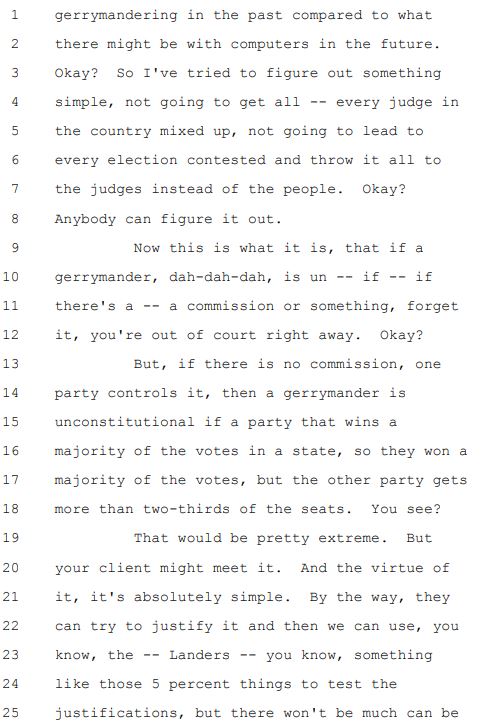
Following up on my prior monitoring of the length of Breyer questions, yesterday's oral argument in Lamone v. Benisek prompted the following question/hypothetical from Justice Breyer:


This 59-line Breyer "question," or "Breyer Page" appears to be a new record, as the last record I've been able to locate was a 57-line Breyer Page in Gill v. Texas that Josh Blackman flagged back in 2017. Audio of the argument is not yet available, so I do not know yet if this is the longest Breyer Question ever asked in terms of length of time.

READ MORE - A 59-Line Breyer Question

Labels:

A Lottery Winnings Contract Hypothetical

Tuesday

Due to the overzealous sharing of dubious content, this Facebook Post showed up on my news feed earlier this evening. Here's a photo of the post:


Unless you expand the photo, the writing may be difficult to read. The photo shows several Mega Millions lottery tickets under the following text:

October 22, 2018
Mega Millions Proposition
I Christopher Ferry, herby [sic] agree to equally share 100% of the earnings I win from the Mega Millions drawing on Tuesday, October 23rd, 2018 with all parties that like, share and comment on my Facebook post that states this propostiion [sic]. This is an official legal document that can be used in the court of law. 

It's then signed, presumably by Christopher Ferry. The writing is in all capital letters, so I took the liberty of guessing at the intended capitalization rather than hurt your eyes.

After liking, sharing and commenting on the post (just kidding), I made the foolish mistake of reading the comments. There seem to be many people out there on the Internet who are confused about the basics of contract law. 

To those confused souls, I now say, you're welcome.

A surprising number of very confident commenters on the post noted that the document was not legally binding because it was not notarized. This is nonsense. While notarization may be required for certain documents or agreements, parties can enter into contracts with each other without notarization. Take, for example, oral agreements, or the website terms of service for reading this blog post, which state that by reading this I now own a small, yet noticeable percentage of your soul and that you are required to enter into binding arbitration with me to prove otherwise. This story of a winning lawsuit to claim a portion of lottery winnings as a result of a verbal agreement is yet another example. People can, and do, enter into non-notarized contracts every day. 

A smaller number of commenters speculated that the document may not be legally binding because it had numerous spelling errors. While spelling errors may occasionally be of legal significance (by misidentifying parties or terms, or injecting vagueness into the agreement), the errors here do not appear to have this effect. If spelling errors meant doom for legal documents, than a disturbingly massive percentage of contracts, pleadings, and judicial opinions would be rendered void.

Some other folks point out that the document is not legally binding because there is only one signature on it. A contract, they think, needs to be signed by all parties that are bound by it. This does not appear to be the case here, however, as Ferry's post is an offer that invites acceptance by performance. Ferry indicates that to accept his offer of sharing the earnings he receives, a party need only "like, share and comment on my Facebook post that states this propostiion [sic]." Once a party has done that, that person or entity will have fulfilled their end of the agreement.

On a related note, if Ferry ends up winning, a likely way he will whittle down the number of those who may have a claim against him will be to refuse to compensate anyone who did not completely perform their side of the agreement. Ferry notably requires that parties "like, share and comment" on the post, so anyone who only likes, or only comments would not have fulfilled their end of the bargain. His comments could make this issue a little more interesting, as he states that only those who "LIKE / SHARE / COMMENT" are eligible -- but these comments are parol evidence which some courts may deem inadmissible (particularly since the terms of the contract itself are fairly clear). And even if Ferry's comments are considered, they do not appear to contradict the terms of the agreement.

In short, the offer may give rise to a binding contract, provided that the party claiming to accept the offer has liked, shared, and commented on the post.

Unfortunately for Ferry, if he wins anything in the lottery, he will be required to share those winnings with anyone who fulfilled the requirements that he posted. Whether that is $1.6 billion or $2.00 -- Ferry agreed to share "100% of the earnings" that he would win, rather than limiting his performance only to a situation in which he won the jackpot. At the time of this writing, there are only about 30 minutes to go, but it will be interesting to see if Ferry wins a substantial amount, but less than the jackpot, as this may be enough for certain delightful people on the Internet to seek to recover their $1.32 to which they are entitled.

It's also fun that Ferry states that the document "can be used in the court of law." 

Good luck to Mr. Ferry, and to all others out there who, like me, are excited for their inevitable life of leisure once the winning numbers are announced.

READ MORE - A Lottery Winnings Contract Hypothetical

Labels:

"Don't Be a Lawyer"

Thursday

I recently read an article by an anonymous author urging readers to avoid becoming attorneys, noting various troubles facing the profession and the difficulties facing those starting out. Here are some of the relevant excerpts:

The competition is terrific. Under prevailing conditions, legal ability is no longer a prerequisite to success. The lawyer without connections is a business-getter, or he rots in his office. Wiles have so boldly supplanted ethics that we have had in recent swift succession a receivership scandal, an ambulance chasing scandal, and a jury-fixing scandal. The integrity of the profession is constantly impugned in the press, and all lawyers are under a cloud. 
It is only the dearth of other employment that keeps the counselors in my town from deserting in droves. Many barely earn their keep, or are assisted by parents, in-laws, or wives. They no longer expect a steady income from law, but live only in hope of a steady job or a political sinecure. Recently a prominent young attorney quit the profession to become a shoe salesman. Others have gone into insurance, bookselling, and storekeeping. One is now the happy proprietor of a fruit stand. 
. . .  
I believe that the harassments which have made the practice of law so dismal today are due principally to overcrowding. My state did not contain a single law school ten years ago; now there are three booming ones. Huge morning, afternoon, and evening classes accommodate everybody. In ten years, the number taking bar examinations has increased by 348 percent.  
. . .  
Hopelessness has sunk deep into my profession, but most pessimistic of all are the newcomers. If I were a young attorney beginning the practice of law in my community today, I should be at my wit's end to earn a dollar, unless I were resolved upon wholesale disregard for ethics. The sharpster has a way of coming out on top nowadays, and survival has come to be most certain for those lawyers who are willing to meet vicious competition with still more vicious practices. It is a condition fraught with serious consequences for the public as well as for the ethical practitioner in law.  
. . .  
Decent youngsters would be better off these days if they raised potatoes instead of practicing law. There is little money in either, but at least from potatoes you derive some satisfaction, and retain your self-respect.
This fairly standard set of indictments against the legal profession is quoted from the straightforwardly-titled article, "Don't Be a Lawyer," which was published in The American Mercury in 1936, and which I found in an April, 1936 edition of Reader's Digest. I'm a bit miffed to be discovering this article now, as I have already become a lawyer, and in the 75 years between the publication of the article and my enrollment in law school, nobody thought to refer me to the author's warnings.

While I have not been able to locate a version of the article online, after a bit of searching, I located this response by William Cain which was published in the Notre Dame Lawyer in November, 1936. Cain criticizes the "pessimistic mental wanderings" of the anonymous author and writes that while many of the facts the author set forth are true, the article focuses on the worst practitioners of the legal profession -- a profession that is primarily composed of "learned, courageous and upright men." (This is not entirely true -- there were learned, courageous and upright women in the legal profession as well, in as early as 1869). Cain points out that the author's selective focus on negative examples could employed to call for readers to avoid the medical profession, business of banking, and institution of marriage.

From Cain's response:
Notwithstanding my anonymous friend's statement that legal ability and real talent are no assurance of success, my own intimate observation and experience of over thirty years active practice at the bar is exactly the reverse. In all that time, I have never known any lawyer with moral courage, ability, integrity and dependability who has failed to enjoy a satisfactory practice yielding amply sufficient pecuniary returns to support himself and family in decency, and to properly educate his children. None of them are, or ever will be, millionaires. None ever wanted to be. Their burning and abiding ambition was to become competent lawyers, and to enjoy the trust and confidence of the communities in which they lived and wrought, and this they achieved. And whatever others may call it, I call it "success."
Things have changed, and I suspect that by now there are some decent lawyers who have managed to surpass that million-dollar mark. But the anonymous article and Cain's response show that present-day arguments about the feasibility of joining the legal profession stretch back farther than one might initially suspect.

READ MORE - "Don't Be a Lawyer"

Labels:

The Second Amendment and Legislative "Protection" of Constitutional Rights

Tuesday

This column in yesterday's Des Moines Register by the Editorial Board caught my eye. It begins:

Is state Rep. Chip Baltimore clairvoyant?
The Boone Republican was arrested last week, charged with operating a motor vehicle while intoxicated and possession of a firearm while under the influence of alcohol. Interestingly, less than 10 months ago, he voted to support legislation reducing penalties for toting a gun while drunk. Lucky for him, that bill was signed into law.
According to a police report, Baltimore was stopped by an Ames officer early Friday morning after authorities received reports of a reckless driver traveling northbound on Interstate Highway 35. With his slurred speech and bloodshot eyes, he told the officer he was on his way home after attending meetings in Des Moines, the report said.
. . .  
Last legislative session, Baltimore was among the lawmakers who supported the Iowa Omnibus Gun Law.

Before this law went into effect, carrying a firearm while intoxicated was an aggravated misdemeanor, punishable by up to two years in prison. An OWI conviction provided clear grounds for revocation of a permit to carry a weapon.

The new law, which went into effect July 1, cuts in half potential jail time and allows drunken drivers the ability to keep their permits to carry handguns.

At the time, one Iowa sheriff questioned the change, baffled that state legislators recognized the danger of operating a vehicle while drunk but not carrying a lethal weapon while intoxicated.


“We know alcohol blurs judgment,” said Black Hawk County Sheriff Tony Thompson. “I’m not sure what the driving force was behind watering that down.”

The Register's earlier article reporting Baltimore's arrest is here. Notably, Baltimore was stopped when an officer observed him driving at 55 mph in a 70 mph zone entering a 65 mph zone. For those interested in DUI-related trivia (who isn't?), the National Highway Traffic Safety Administration states that driving at 10 miles or more below the speed limit is an indicator of possible impaired driving. The same is not true of speeding.
 
This story is my quirky introduction for a much broader discussion of misleading rhetoric regarding the "protection" of constitutional rights through legislation. For those only interested in the adventures and apparent foresight of Chip Baltimore (and accompanying DUI trivia), stop reading now!

The Omnibus Gun Law referenced in the column was lauded by advocates upon its passage as a victory for Iowans' Second Amendment rights. The Washington Post reported on the passage of the bill back in April 2017:
Branstad, the long-serving Republican governor selected by President Trump to be ambassador to China, signed a bill that many say is the most comprehensive and broadest piece of legislation on gun rights the state has ever seen. House File 517 will, among other things, allow citizens to use deadly force if they believe their lives are threatened; it will also allow them to sue local government officials if they think gun-free zones have violated their Second Amendment rights.

The signing of House File 517 last week marks the end of a decades-long battle for a bill that does more than make incremental changes to the state’s gun laws and will bring Iowa in line with its more gun-friendly neighbors such as Missouri and Wisconsin, said Barry Snell, president of the Iowa Firearms Coalition, an advocacy group affiliated with the National Rifle Association.

“Without exaggeration, House File 517 is the most monumental and sweeping piece of gun legislation in Iowa’s history,” Snell told The Washington Post. “Never before have we passed a bill in which Iowa’s Second Amendment rights are legally recognized, claimed and protected quite so profoundly as this bill does.”
Snell's statement expresses a familiar sentiment, but also reveals a common misconception about how constitutional rights function in relation to laws passed by legislatures. State laws are not needed to recognize or protect constitutional rights. If a law restricts the right to bear arms so much that it violates the Second Amendment, those who are burdened or injured by the law may challenge it and the courts will strike down the law if it is unconstitutional. The scope of the Amendment is a matter of constitutional law that is ultimately determined by the United States Supreme Court -- not by legislatures.
 
While I'm not surprised to see this sort of misleading rhetoric used by the head of an advocacy group, the article quoted Professor Randy Barnett who blogs at the excellent Volokh Conspiracy, who made an unfortunately similar point:
The legislation might make Iowa “the leading edge of protecting the civil right” to bear arms, said Randy Barnett, a law professor at Georgetown University.
“When you have a constitutional right, it often requires the legislation to protect that right,” Barnett said. “That’s what Iowa is doing.”
Of course, states may use legislation or amend their own constitutions to reduce government's ability to restrict gun possession use. For example, Louisiana amended its state constitution to state that any law restricting the right to bear arms is subject to strict scrutiny review in the courts -- a standard that is likely higher than the (admittedly unclear) approach required by the Second Amendment to the United States Constitution. But the action of legislatures is not required to protect constitutional rights -- rather, it is the purpose of judicial review is to place protection of these rights in the hands of the courts.

I've expressed approval for certain state laws or constitutional provisions that effectively expand the scope of federal constitutional rights. Laws that do this in the Fourth Amendment context restricting unreasonable searches and seizures, for example, are a good idea -- particularly when it comes to developing technology like drones. Courts, particularly the United States Supreme Court, may be slow to react to rapid changes and the complexities of new technologies, and the legislature -- if properly informed -- can impose restrictions on law enforcement that fill in holes in the doctrine. Of course, I would not say that these laws are necessary to protect the Fourth Amendment. At most, I'd say that these laws protect people from intrusion by the government in instances where the Fourth Amendment may not apply, or may not clearly apply, and therefore are consistent with the spirit of the Fourth Amendment.

Barnett would likely argue that the courts cannot protect all violations of constitutional rights. People may lack the resources, time, or will to pursue a constitutional challenge, and laws may prevent circumstances from arising that give rise to the violation of rights in the first place. This is evident in the Fourth Amendment context, where unlawful searches and seizures are likely conducted hundreds, or even thousands, of times per day. So on a practical level, legislative restrictions may ultimately result in fewer infringements of people's Fourth Amendment rights.

But this argument does not cleanly translate to the Second Amendment context. The Fourth Amendment has been the subject of numerous Supreme Court opinions that have fleshed out a complex doctrine of protections, exceptions, and consequences of Fourth Amendment violations. But the Supreme Court has refused to return to the Second Amendment after its opinions in Heller and McDonald, opting to deny certiorari in some tantalizing cases and leave the development of Second Amendment doctrine to the lower courts. In the absence of continued Supreme Court attention, the ultimate scope of Second Amendment protection remains unclear and inconsistent across different circuits. To claim that Second Amendment rights are frequently violated and that these violations are not addressed by the courts is therefore a far less certain proposition than a similar claim regarding the violation of Fourth Amendment rights.

When politicians and academics say that laws are necessary to protect and preserve the Second Amendment, they are, at best, speaking imprecisely and, at worst, being misleading. Instead, these advocates are assuming that the unclear Second Amendment right provides certain protections and asserting that these protections be enshrined in the law in order to uphold the right. A lack of clarity and a failure of the Supreme Court to set clear standards or to revisit the Second Amendment are translated into a claimed need for legislative action -- and laws purporting to "protect" the right are born as a result.

The courts will protect rights, striking down overly restrictive laws if need be. Whether the rights are broad or narrow is for the Supreme Court to decide. Legislatures, in turn, may opine as to the spirit of constitutional rights and pass laws that provide additional protections that are consistent with the spirit of the rights. In the case of the Second Amendment, the Iowa legislature apparently believes that the spirit of the Second Amendment protects people from severe criminal penalties should they be carrying a firearm while drunk. And if the rhetoric of Snell and Professor Barnett is to be taken seriously, this is apparently what the United States Constitution envisions as well.

If lawmakers believe that respecting and protecting the Second Amendment requires legislation that decreases the penalties against those who carry firearms while intoxicated, then it's the legislature's prerogative to enact such legislation. All I can say at this point is kudos to Representative Baltimore for his foresight in supporting this legislation, and to implore advocates like Snell and Barnett to think about the legislature's role in relation to the Second Amendment before making overly broad claims.

READ MORE - The Second Amendment and Legislative "Protection" of Constitutional Rights

Labels:

Star Wars: The Last Jedi: The Review of the Shapiro Review

Monday

I watched Star Wars: The Last Jedi when it first opened. While there is a lot to digest, I enjoyed the movie overall. I've been meaning to watch it again, but in the meantime, I have been taking in the odd phenomenon of self-proclaimed Star Wars enthusiasts who often happen to be political conservatives attacking the film. With every negative review I read, the more I like The Last Jedi.

Which is why after all of the presents were unwrapped on Christmas morning, this tweet from Randy Barnett was a nice bonus gift:

I don't pay attention to Ben Shapiro because why should anyone? But Randy Barnett is a law professor and noted conservative voice who blogs at the excellent Volokh Conspiracy -- making me all the more sad to see him promoting what turns out to be repetitive, ill-conceived complaining about The Last Jedi.

For those of you who enjoy reading negative reviews of the movie like I do, I recommend reading Shapiro's review first, which you can find here. And because it is Christmas day, the presents have all been opened, and I still have a lot of leftover rage from some family ping pong games, my response to Shapiro's review is below the break. There are many spoilers, so don't read ahead if you want to avoid those.

It should be noted that Randy Barnett is a law professor and Ben Shapiro apparently went to Harvard Law, so that should be enough of a legal hook to let me post it on this law blog.

Shapiro's criticisms are numbered in an attempt to hoodwink the audience into believing that repetition and verbosity are hallmarks of sophistication. The numbers and taglines of each complaint are listed below, and Shapiro's complaints are summarized when necessary, but for the full version of each, you will need to read his article which I am not going to re-quote in its near-entirety here.

1. The Force Awakens Apparently Never Happened. 

Shapiro is confused why the First Order still has weapons after their base was destroyed. Why this translates into The Force Awakens never happening is unclear, as only the base was destroyed in that film. The same criticism could be made of Empire Strikes Back, where the Empire still has numerous ships, including a Super Star Destroyer, after the Death Star's destruction. But nothing in Star Wars: A New Hope or The Force Awakens suggests that anything other than the large planet-destroying base was destroyed, so this criticism, which would have been senseless in the age of Empire, is senseless now.

2. There Is No Gravity In Space.

Again Shapiro takes aim at the beloved Empire Strikes Back. Wait -- as it turns out, he's not criticizing the scene in Empire where Tie Bombers drop bombs on an asteroid in which the Millennium Falcon is hiding. Instead he is criticizing the opening scene where a bomber drops bombs on a First Order Dreadnought. Shapiro admits "It's a cool scene," but adds it to his list for the sake of volume (even though he ends up with an awkward 19, rather than 20, criticisms). Ignoring the possibilities that the bombs could have been calibrated to seek out the (admittedly weak) gravity of the (huge) Dreadnought, or even a more basic explanation of mechanisms that kick the bombs out into space and/or magnets that activate after a delay, Shapiro decides that the film is worthy of criticism for not explaining every little detail. This is the first step on a dark path that leads to Midi-chlorians.

Also there is no sound in space, and has Shapiro ever criticized that? Probably not.

3. Snoke Is A Throwaway.

Shapiro is angry that Snoke dies before the third movie because he apparently wants Episodes 7-9 to completely retread the plot lines of the original trilogy even though this was the biggest problem with The Force Awakens (no, Rey being able to use the Force effectively despite being a woman whose extensive experience spelunking through wreckage and abilities to fight off multiple attackers with a stick should give her a far stronger baseline for reflexes, strength, and combat abilities in general untrained is not the biggest problem with The Force Awakens).

Snoke was an arrogant jerk who treated Emperor Palpatine the same way that Kylo Ren treats Darth Vader. Snoke stole the giant-head hologram (wonderfully used in The Last Jedi), large swivel-chair, and red-guard fetish that the Emperor had. Rather than keep this guy around for too long, he is killed off in a sudden manner that is surprising, new, and that leads to an excellent lightsaber vs. energy sword/spear/etc. fight.

4. Kylo Ren Isn’t Intimidating.

Shapiro complains that Kylo Ren not being competent, strong, or Darth Vader-y enough is "the biggest problem." Shapiro wants the films to sacrifice what makes Kylo Ren interesting (his conflicted nature and the fact that he is still growing in power and knowledge of the Force) in favor of him filling the Darth Vader gap that cannot and should not be filled. And to the extent that Shapiro argues that Kylo Ren is difficult to see as "the ultimate bad guy," it is unclear if this is the role that Kylo Ren is supposed to play, and leaves open many new and interesting directions that Episode 9 may take.

5. Rey’s Backstory Sucks.

This criticism is so misguided that it is worth quoting in part:
The series wanted to reset so that anybody could have abilities with the Force — a laudable goal. But by sucking Rey out of the family drama, we’re no longer dealing with the central storyline — a point Kylo Ren makes to Rey openly. I guess the idea is that we’re supposed to now think that small street urchins without any sort of bloodline can become incredible Jedi. That’s democratic, but it’s not true to the storyline, and it doesn’t provide any drama.
Does Shapiro think that Mace Windu, Yoda, Plo Koon, and Ki-Adi-Mundi were all related? The prequels established that the Jedi kidnap? recruit small children from all over the place into their ranks if they are discovered to be Force-sensitive. That broom kid would be gone in a second if those boring old codgers were still sitting around in that tower. Shapiro's complaint that Rey is not a Skywalker or a Kenobi therefore both ignores canon and avoids what made A New Hope so appealing -- the notion that some random farm kid could turn out to be a hero with powers who eventually took down a laser-moon.

6. Luke’s Weird Farmer Life Is Weird.

Shapiro's full complaint is:
Did we really need a whole day of Luke going around milking an alien seacow and drinking it?
Absolutely. That scene is iconic.

7. Luke Is A Bad Teacher.

Luke doesn't want to be a teacher and his confidence has been shattered by his disastrous last attempt. Luke's reluctance to teach and lack of thorough lessons makes sense. Shapiro, however, is correct to the extent that I wanted more scenes with Rey carrying Mark Hamill around in her backpack.

8. Celebrity Cameos Make No Sense.

Shapiro apparently thinks that Laura Dern and Benicio Del Toro are "celebrity cameos." These are not cameo appearances. Justin Theroux briefly appearing as the Master Codebreaker is a cameo. Daniel Craig playing a stormtrooper in The Force Awakens was a cameo. Laura Dern and Benecio Del Toro play full-on characters in the film and just happen to be actors that Shapiro knows better.

9. Poe Dameron’s Story Arc Is Foolish.

Shapiro says that "Poe is supposed to be a newfangled Han Solo." No he isn't. Shapiro says that "Poe is a dolt." Not really, although Poe is a hotheaded pilot who needs to learn to be a part of the team, and his learning this is the focus of his character growth in the movie.

Shapiro wanders off into the criticism that Laura Dern should have told Poe her plan, and that Poe ends up making "stupid plans with Finn that have no actual effect on the plotline." Shapiro ignores that the "stupid plans" end up getting most everyone killed, which is an "actual effect." And Shapiro assumes that an Admiral should tell a recently-demoted-for-being-too-impulsive-and-therefore-getting-most-every-Resistance-pilot-killed captain what her plans are.

10. Finn’s Storyline Is Useless.

We are ten criticisms in and finally have a bit of a valid point -- the Finn and Rose adventure on the casino planet did not add very much to the story and at times (read: during the alien horse chase) was goofy. Shapiro, though, argues that Finn should have died in the last movie and in this one and says that nothing comes from Finn's story. Finn is an interesting character who ultimately grows as a result of his (yes, silly) quest from being a deserter to a man willing to die for a cause and finally confronts his old tormentor, Phasma, head on.

11. Rose Is Useless.

Rose both helps Finn grow and serves to show that the briefly-seen pilots and ground crew of the Resistance have interesting backstories and can become heroes themselves and who may have even more notable and interesting roles in future films. But the movie did not count out the possibility that she is a Skywalker, so don't count her out so quickly, Shapiro.

12. Social Justice Warrioring On Interplanetary Monte Carlo Is Awful. Awful.

The one interesting thing about the casino planet was the notion of third parties profiting from the war -- a dimension that we have not yet seen, and a notion that hints at happenings in the galaxy as a whole. We should probably start thinking this way if Rian Johnson's next trilogy is going to be set beyond the immediate back and forth between the Empire/First Order and Rebellion/Resistance. Also, it's strange that pointing out alien-animal abuse is "Social Justice Warrioring." Using enslaved animals to one's advantage against the enemy is a time honored Star Wars tradition (or, at least it happened with dinosaurs in the (amazing) Ewok movie, The Battle for Endor). Also, stop trying to make "Social Justice Warrioring" as a verb happen, Shapiro.

13. Captain Phasma Is A Nothing.

So was Boba Fett, but everyone loves him. At least Phasma briefly has some cool moments, displays an evil personality, and has a fight scene. As you can see, in part, here, Boba Fett stood around, said five words, got his gun disabled immediately, fired a useless rope, took an awkwardly long time to raise up his arm which had another gun on it, fired two shots, and then was accidentally knocked into the mouth of an alien ant eater. But everyone loves him.

14. Luke Shouldn’t Have Been A Hologram.

Shapiro's criticism here is borderline incomprehensible.
Why is it cool for Luke to survive a barrage from AT-ATs if he’s not even there?
...it makes sense that he survives because he isn't there. And it's cool for several reasons, the most obvious of which is him dusting off his shoulder.
Why is it cool for Luke to best Kylo Ren in a light saber battle if (1) Rey has already done so, and (2) Luke isn’t even there?
...he doesn't best Kylo Ren, and the no-contact hologram fight is pretty cool and leads to a surprise that he isn't there.
They easily could have brought Luke there, and had him do exactly the same thing, but sacrifice himself — or perhaps just fade away in front of Kylo Ren.
I hope that Shapiro sticks to being a "Provocative Gladiator" and never somehow stumbles into writing for these movies.

15. The Powers Of The Force Aren’t Magic.

I too wish that the Force only kept doing what it did in the earlier films and that it was never used or developed in interesting ways.

16. Light Speed Can't Be Used As A Weapon.

Shapiro correctly (what?!) points out that if light speed could be used as a weapon, it would be used more often. While that is a bit of a hole, the upshot is not that light speed "can't" be used as a weapon, so Shapiro's argument is muddled and pointless. Most importantly, Shapiro calls into question the best moment in the film and one of the best moments in the series. I don't care if it raises questions or if there are plot holes, the hyperspace moment was fantastic.

17. Why Would Luke Try To Kill Kylo?

Because he was never raised as a Jedi, nearly killed Vader before he finally stopped hacking at him, has killed SO MANY people, and has finally built something after a lifetime of seeing many of those close to him die only to see that thing on the verge of being torn down. I've seen other self-proclaimed Star Wars nerds raise this point as well, and it boggles the mind how little clue they have about Luke's experiences and the effect that they might have on a person.

18. There Are No Interesting Characters Left Except For Kylo Ren.

Shapiro complains that the characters from the original trilogy are no longer around and misses the whole point of the new movies handing the story off to a new generation. As for the new characters, Shapiro argues that Rey has a "crappy backstory," (ENOUGH with everyone needing to be a Skywalker), "Finn is a nonentity," (what does this even mean, and no, he has heart, is funny, and is the first character we have seen cross over from a background of serving the bad guys to the side of the Rebellion/Resistance), and "nobody cares about Rose," (nobody cares what Shapiro thinks about Rose).

19. Kylo Should Have Sided With Rey.

"This is the biggest problem of all."

Shapiro's list is so bloated that he forgets that the "biggest problem" was previously listed at number four: Kylo Ren's lack of being intimidating and no longer being a credible "big bad." Not only is this sloppy writing, it is a fascinating contradiction. Kylo Ren should be scarier and a more intimidating bad guy, but he ALSO should have joined up with Rey? And, "Kylo is far more interesting as a character trying to hold his darkness in check than as a guy who gives into it" misses the point.  What makes Kylo Ren interesting and new is that he is trying to be evil, but is being occasionally won over by the good that is still in him. Kylo Ren's conflicted nature makes him a compelling character, but having him join up with Rey would have been a redemption that a character who killed Han Solo (and many, many others) a few hours ago does not deserve.

Shapiro goes on to undo a bit of his article's nonsense by pointing out some good things about The Last Jedi, but it is too little, too late. If anyone has any other problems they want to point out with the movie, feel free to leave them in the comments where I may or may not address them.

READ MORE - Star Wars: The Last Jedi: The Review of the Shapiro Review

Labels:

Thor: Ragnarok Does Not Exemplify Trial By Combat

Tuesday

Over at the ABA Journal, Adam Banner claims that Thor: Ragnarok is the "latest instance of trial by combat in popular culture." He writes (don't worry, no spoilers yet): 

First off, if you haven’t seen the new Thor film, I highly suggest it. It’s one of the best entries in the Marvel Cinematic Universe, and it contains one of the best scenes any fan could ask for: a battle between the God of Thunder and a giant, green rage monster. Without giving too much away, Thor is promised his freedom if he can best his captor’s “champion” in combat—it just so happens that champion is a super-angry Hulk. Trial by combat? Definitely.
I've seen Thor: Ragnarok twice (it's fantastic), and I've written a fair amount about trial by combat (see blog posts here, here, and here and a peer reviewed (!?) article that I coauthored with my former classmate, Raj Shah here). After reflecting on the history, basis, and characteristics of historic (and even Game-of-Thrones-style) trial by combat, the fight between Thor and Hulk in the movie cannot be fairly characterized as an example of trial by combat.

Banner (what a name for a guy writing about a fight that involves the Hulk) decides to write his article without spoilers, which allows him to advance his claim behind a fog of uncertainty that maybe there are other events in the movie that make the fight into a trial by combat scenario. I'll get into the nitty-gritty of the events leading up to the fight in the movie after the break, so I guess there are some minor spoiler alerts for those who didn't watch the trailers and put two and two together.


Banner's summary of historic trial by combat is a broad-stroke treatment, but is generally correct -- in instances of trial by combat in medieval England, the theory was that the victor in the combat was the one favored by God (an outcome made all the more likely by both participants taking oaths against sorcery or witchcraft). Banner does not mention the fact that trial by combat in medieval England typically involved a combat between champions selected by parties to a dispute, although he references Game of Thrones several times which employed a similar approach.

An important element of trial by combat is that it was typically employed as a method of dispute resolution. If arbitration between the parties or the court's involvement left the dispute unresolved, trial by combat remained as a last resort to settle the matter.

With that in mind, consider the background leading up to the fight between Thor and the Hulk. Thor is thrown through space and crashes onto the planet, Sakaar, which has a brutal system of quasi-government in which the Grandmaster (Jeff Goldblum) oversees a series of gladiatorial matches in his arena. Roving bands of scavengers roam the surface of the planet and either eat stragglers or, in the case of Thor, capture them so that they become slaves "prisoners with jobs" who fight in the Grandmaster's arena.

Thor is captured and forced to fight in the arena. The Grandmaster tells Thor that if he defeats the reigning Champion, Thor will be freed. This Champion turns out to be the Hulk, and after some initial attempts to amiably avert a fight, battle ensues.

This is not an example of trial by combat because, despite Banner's claim that there is a dispute, there is no underlying argument that the combat is designed to resolve. Hulk and Thor are not champions for parties disagreeing with each other, and the guilt or innocence of the parties for some crime is not an issue to be resolved in the combat. At best, Banner might claim that there is a dispute between Thor and the Grandmaster as to whether Thor should be freed, with Thor's victory assuring his freedom, and his defeat ensuring that he becomes another Doug. But this is not so much a dispute to be resolved as an incentive to goad Thor into participating in the fights. Thor is never on equal footing or able to present any sort of case against the Grandmaster, and is instead just a prisoner fighting for freedom, rather than a party fighting for a side of a case. While this could be an interesting metaphor for whether defendants (and especially prisoners) in the US criminal justice system have any sort of fair shot in proving their innocence or in seeking habeas relief, this gets us off of the subject of trial by combat (although it leaves us with some interesting ideas for future thinkpieces on the film).

As much as I love to see attention drawn to quirky areas of the law like trial by combat, Thor: Ragnarok is not an accurate example of the practice. Banner's oversimplification of the practice and failure to address the background of the Thor vs. Hulk fight unfortunately lead him to the wrong conclusion. I can only hope, for my sake, that if Banner ends up reading this post, it doesn't end up making him angry.

READ MORE - Thor: Ragnarok Does Not Exemplify Trial By Combat

Labels:

Bacongate: Did Senator Leahy Read My Confirmation Hearing Outline for Justice Willett?

Wednesday

Business Insider reports on a ridiculous exchange between Senator Patrick Leahy (D-VT), and Fifth Circuit Court of Appeals Judicial Nominee, Texas Supreme Court Justice Don Willett, a video of which is below:


Back when Justice Willet was being considered as a potential Supreme Court nominee, I wrote this post highlighting questions that could be asked at Willett's confirmation hearing based on his prior tweets. From that post, here is one of my potential questions (and the accompanying tweet):

As a Supreme Court Justice (or federal judge) would you be willing to expand the Supreme Court's previous decisions that expanded the definition of marriage?


In a fascinating display of either: (1) failing to understand simple humor; or (2) extreme partisan interpretation, Leahy lambasted Willet's tweet as an attack on gay marriage and the Supreme Court's decision legalizing gay marriage. From Business Insider:
"I don't think one would see that as praising the Supreme Court decisions," Leahy said of the tweet.
While I am happy that I was able to predict at least one of the tweets that would come up in Willett's confirmation hearing, Leahy taking the tweet in this direction made a farce of his line of questioning. Senators with concerns about Willett taking conservative stances on legal issues certainly have plenty to work with, but this exchange is just (to use some legal terminology) goofy.

All of this aside, I will assume without evidence that Senator Leahy got the idea to ask about that tweet by reading my blog, and I thank the good Senator for his attention to my work.

READ MORE - Bacongate: Did Senator Leahy Read My Confirmation Hearing Outline for Justice Willett?

Labels:

Plaintiff Asks Court to Declare That Defendant is a "BULLY"

Tuesday

From this tweet by Keith Lee, I learned of this fascinating Complaint filed on Sunday in the New York County Supreme Court. Lee takes note of the first two paragraphs of the Complaint, which are admittedly colorful:

1. The date, September 7, 2017, is a date that shall live in infamy in Staten Island history. On September 7, 2017, the circus came to town. The Defendant, DENNIS W. QUIRK (“QUIRK”) in his individual and personal capacity exploded on the courthouse steps as part rabid-dog and part carnival-barker, in a dangerous, intentional, outrageous, and malicious manner. QUIRK caused serious, substantial, unconscionable, intentional, and malicious harm to the Plaintiff, MICHAEL J. PULIZOTTO (“PULIZOTTO”), in the center of the public square – the steps of the Richmond County Courthouse – all to advance QUIRK’s own personal and political agenda.
2. The date, September 7, 2017, shall always and hereafter be known as “THE DAY OF THE RAT” in Richmond County.
The Complaint goes on to allege that Quirk set up a large inflatable rat outside the parking lot of the courthouse in an effort to ridicule Pulizotto, among many other things. Notably, in Paragraph 2, Pulizotto does not only use "THE DAY OF THE RAT" as shorthand for future reference in the document (as he does with "QUIRK" and "PULIZOTTO"), but dramatically states that September 7, 2017 shall be known as "THE DAY OF THE RAT" in Richmond County. It is unlikely that the Court has the authority to make such a declaration (as such a declaration would likely be within the province of county authorities), but Pulizotto does not seek the labeling of that date in his prayer for relief.

While I found much of the Complaint entertaining, due to its length and excessive hyperbole, I was not able to read the entire thing. But as I skimmed through, these two paragraphs caused me to chuckle:
56. Merriam Webster Dictionary defines “BULLY” as a blustering, browbeating person; especially: one who is habitually cruel, insulting, or threatening to others who are weaker, smaller, or in some way vulnerable.
57. QUIRK is a BULLY.
As it turns out, these two paragraphs end up being relevant to Pulizotto's causes of action, specifically, his cause of action for declaratory judgment. For those who need to brush up on their remedies, a declaratory judgment is: "A binding judgment from a court defining the legal relationship between parties and their rights in the matter before the court" which does not provide for enforcement.

What sort of declaratory judgment does Pulizotto seek?
AS AND FOR A SIXTH CAUSE OF ACTION ON BEHALF OF PLAINTIFF(DECLARATORY JUDGMENT)
181. Plaintiff, PULIZOTTO, repeats, realleges, and restates all paragraphs above as if fully set forth herein and further states as follows.
182. As specifically plead above, a bona fide, justiciable, and substantial controversy exists as between the Defendant, QUIRK, and the Plaintiff, PULZOTTO [sic].
183. The Defendant, QUIRK, and the Plaintiff, PULZOTTO [sic] have adverse legal interests.
184. A judgment would serve a useful purpose in clarifying or settling the legal issues as between the Defendant, QUIRK, and the Plaintiff, PULZOTTO [sic].
185. There is a clear and ascertainable standard for the Court to rule on this issue, to wit: Merriam Webster Dictionary defines “BULLY” as a blustering, browbeating person; especially: one who is habitually cruel, insulting, or threatening to others who are weaker, smaller, or in some way vulnerable.
186. A judgment would finalize the controversy and offer relief from uncertainty as to whether the Defendant, DENNIS W. QUIRK is a “BULLY”.
And in addition to the $25 million in compensatory and punitive damages that Pulizotto seeks in his Prayer for Relief, he also asks for:
G. a declaration that: “DENNIS W. QUIRK IS A BULLY.”;

 
Declaratory judgments may be used to stop litigation "bullies" from sending repetitive demand letters or making meritless threats of litigation, but this is the first instance of which I am aware in which a party has sought to use the remedy to give its name calling the force of law. While Quirk likely does not want to be called a "Bully," the "BULLY" label that Pulizotto seeks is of no legal consequence and bears no apparent relevance to the parties' legal relationship or rights, the Court will almost certainly refuse to grant Pulizotto the requested relief on this cause of action.
 
Pulizotto may well have strong, negative feelings toward Quirk, but incorporating such a petty and futile cause of action into his Complaint will likely do nothing but harm his credibility before the Court in future proceedings. This Complaint and its dramatic language therefore join the vast ranks of pleadings that are amusing, yet awful examples of how litigants should act.

[UPDATE, 10/18/2017]

Another no-no I just noticed in the drafting of the Complaint is that the Plaintiff repeatedly misspells his own name. I have updated the above quotes with [sic]'s so that readers do not accuse me of shoddy copying and pasting.

READ MORE - Plaintiff Asks Court to Declare That Defendant is a "BULLY"

Labels:

A 32-Line Justice Breyer 'Question'

Monday

Behold!


From oral argument today in Beckles v. United States. H/T Josh Blackman, who helpfully notes here that Justice Breyer's record is 44 lines.

READ MORE - A 32-Line Justice Breyer 'Question'

Labels:

Revisiting Chemerinsky's "Return of the Jedi" Analogy

A little over a year ago, I wrote a post criticizing Erwin Chemerinsky's characterization of the Roberts Court's liberal October 2014 term as the Return of the Jedi. My criticism was both technical (Chemerinsky suggested that the October 2014 term may be followed by The Empire Strikes Back), and based on a desire for the ideal Star Wars metaphor (I suggested that Star Wars: A New Hope would serve as a better analogy).

While I stand by my technical criticism (Empire came before Jedi, damn it!), Chemerinsky's choice of the Return of the Jedi analogy may have been more fitting than I initially could have known. At the time Chemerinsky wrote his article, I had neither seen The Force Awakens (in which the Empire-themed First Order uses a planet-sized superweapon to destroy entire systems of planets) nor was I aware that Donald Trump would be elected President in 2016, causing unprecedented levels of fretfulness in those who wished to see a liberal Supreme Court.

With Chemerinsky hailing Trump's presidency as the potential end of Roe v. Wade and affirmative action programs, it should be only a matter of days until he brings his analogy home. In the meantime, I would call on any of my readers who attend or are employed at the University of Irvine School of Law to try to locate Chemerinsky's time machine the next time they have the opportunity to visit his office.

READ MORE - Revisiting Chemerinsky's "Return of the Jedi" Analogy

Labels:

Justice Willet: A Confirmation Hearing Outline

Friday

Via Howard Bashman's How Appealing, I learned of this excellent profile of Texas Supreme Court Justice Don Willett by Eric Benson. Since Donald Trump included Justice Willett on his short list of potential Supreme Court nominees back in May, there has been a decent amount of coverage from the fairly generic to the critical to the sensational. Benson's article thoroughly covers the story of Justice Willett's life and career before the Texas Supreme Court, some of his notable moments on the Court, and his activities beyond the judiciary, including his speaking at Federalist Society events and living up to his title as the Tweeter Laureate of Texas.

From Benson's article:
Social media sleuths had combed through @JusticeWillett’s feed and found such Trump-mocking gems as “We’ll rebuild the Death Star. It’ll be amazing, believe me. And the rebels will pay for it. —Darth Trump.” Within the day, the websites of outlets from the Dallas Morning News to People exploded with variations of the headline “9 times Texas Supreme Court Justice Don Willett dissed Donald Trump.” While some political commentators thought Willett’s tweets would make his ultimate selection by the thin-skinned Trump unlikely, the president-elect might well favor a judge prone to the occasional insult. But the attention garnered by Willett’s Twitter jabs obscured a more relevant fact: While the justice portrays himself on social media as little more than a flag-waving, pun-inclined good old boy, he is also a heavyweight of constitutional jurisprudence, one of the leading lights of a polarizing legal movement that has upended the long-sacrosanct conservative doctrine of “judicial restraint,” the mantra of Scalia and Robert Bork.

In a series of high-profile opinions over the past half-decade, Willett has mapped out the contours of this position, championing what libertarian attorney Chip Mellor termed “judicial engagement,” a more aggressive approach to reviewing (and sometimes declaring unconstitutional) government regulations, particularly those that relate to economic and property rights.
I began following Justice Willett on Twitter a while ago, and it is a decision I do not regret. Justice Willett's tweets are often humorous and informative. While Justice Willett's tweets are almost all whimsical, he does not hide his enthusiasm for judicial restraint.

I urge readers to read Benson's full article on Justice Willett. As for the remainder of this post...in the event that Justice Willett is indeed selected as a judicial nominee, whether for the Supreme Court or for another federal judgeship, senators will need to think up questions to ask at the confirmation hearing. Clever senators should approach the hearing as any good lawyer approaches questioning a witness at trial: they should ask questions knowing what the answer will be -- or what the answer ought to be.

With this in mind, here is a list of possible questions senators may ask, along with Justice Willett's paper Twitter trail that shows what his answers had better be:

As a Supreme Court Justice (or federal judge) would you be willing to expand the Supreme Court's previous decisions that expanded the definition of marriage?


As a Supreme Court Justice (or federal judge) will you legislate from the bench?


Do you anticipate that you would ever engage in any form of judicial activism should you be appointed to the Court?


How will you approach discussions with other justices (or judges) who do not agree with your views on a case?

(Here's a non-tongue-in-cheek question, just for fun): Does your inclusion of "#SCOTUS" in this tweet indicate that you would vote in favor of granting certiorari to this case or to a similar case?


What approach will you take toward oral argument?


What is that on your sleeve?


To the numerous United States Senators out there who I am sure read this blog on a daily basis: You're welcome.

READ MORE - Justice Willet: A Confirmation Hearing Outline

Labels:

Blogger Theme By:GosuBlogger and Araba Modelleri .